Connexon
Also called the connexin hemichannel
Each connexon is a ring of six connexin proteins around a central pore, spanning the cell membrane. Through the joined channels ions and small molecules pass directly from cell to cell, so the cells are coupled electrically and chemically. Gap junctions form electrical synapses between some neurons (unlike chemical synapses; see synapse and nervous tissue) and couple heart muscle cells at the intercalated discs so that they contract together; they are also common in the liver, the pancreas and many other tissues. The channels open and close, for example in response to calcium, pH and voltage.
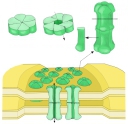 Gap junction and connexons
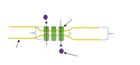 Electrical synapse (schematic)
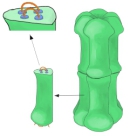 Connexin and connexon
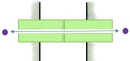 Gap junction (schematic)
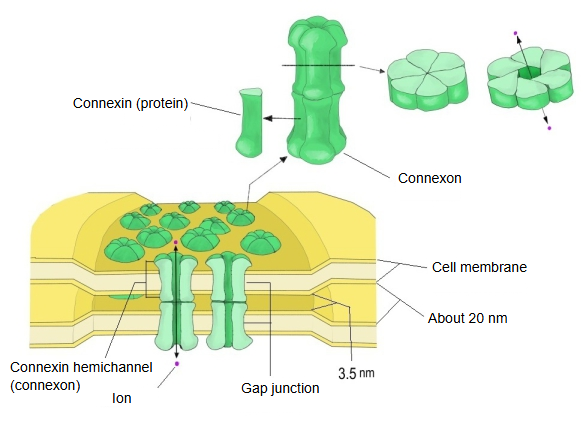
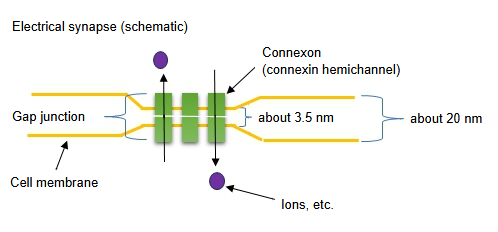
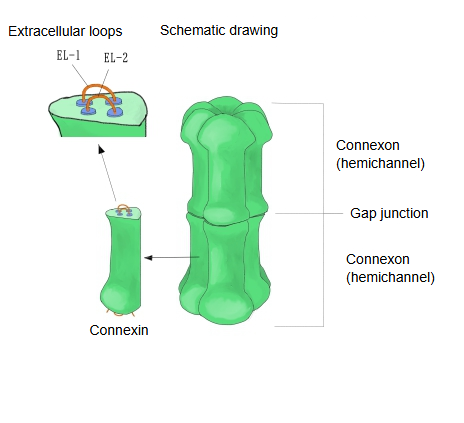
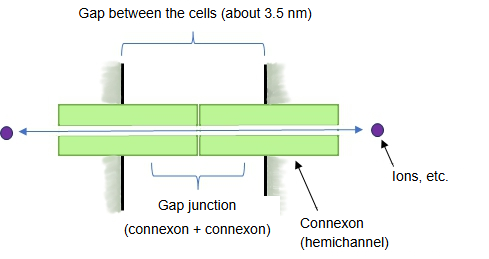
· In some cells the hemichannel by itself works as a channel between the cytoplasm and the outside of the cell, and lets ions and small molecules through (up to about 1 kDa; some sources give 1–2 kDa).
· A connexon built from one kind of connexin is called homomeric; one built from different kinds is heteromeric.
⇒ A website with a useful illustration of connexins, connexons and gap junctions (figure, Elsevier)

· Connexons are especially permeable to soluble second messengers, amino acids, nucleotides, ions and glucose.
· The channels are voltage-sensitive: connexon channels have voltage-dependent gates that open or close depending on the difference in voltage between the two cells.
· The gates can also respond to the voltage difference between the inside and the outside of the cell (the membrane potential).
Assembly of the gap junction
The connexins are made on the endoplasmic reticulum and assembled into connexons in the Golgi apparatus, which are then carried to the cell membrane. Once inserted, the hemichannels move freely within the lipid bilayer. With the help of certain proteins, mainly cadherins, they dock with the hemichannels of the neighbouring cell and form a gap junction; two connexons meet end to end across a very narrow gap (about 2–4 nm). Recent studies show links between adherens junctions and gap junctions, which suggests that their formation is finely coordinated.
Regulation: communication through gap junctions is regulated in several ways. The main ones are:
Chemical regulation: calcium ions (Ca2+) binding to certain parts of the connexins appear to close the pore, although the mechanism is not fully understood. A fall in the pH inside the cell (acidification) also changes the end part of the connexin and lowers the activity of the channel.
Protein phosphorylation: phosphorylation of the connexins regulates communication between cells in several ways: the transport of connexins from the Golgi apparatus, their gathering at particular sites of the membrane and the removal of channels that are no longer needed. The details are complex, but phosphorylation is known to be involved.
Regulation by humoral factors: neurotransmitters, growth factors and other bioactive substances also change the coupling. Neurotransmitters such as adrenaline and noradrenaline modulate gap junctions between nerve cells, for example in the retina, and between the cells of the heart.
Physiological functions
Connexons are important for behaviour and for the physiology of the nervous system; research on them is fairly recent and many details are still unknown. In the central nervous system they play a large part in diseases such as epilepsy, ischaemia, inflammation and neurodegeneration, although the molecular mechanisms are not fully understood. In the heart, gap junctions join the cardiac muscle cells at the intercalated discs, so that excitation spreads quickly and the cells contract together. Connexons also take part in development, for example in the growth of the brain and in its repair after injury, where they help cell division and proliferation; signalling by ATP and other purines released through them is thought to be involved. They also take part in sensing glucose and signalling, which influences feeding, the sleep–wake cycle and energy use, and the uptake of glucose through connexons rises under stress and inflammation.
Related diseases
Some cardiovascular diseases and some forms of diabetes are linked with connexons. In both, the affected sites are the gap junctions of the heart and the pancreas, which allow fast electrical communication between cells. In the heart the main connexin is connexin 43 (Cx43), in the gap junctions of the intercalated discs that keep the beat in step. In heart disease Cx43 shows signs of oxidative stress, and its expression falls after myocardial infarction and in structural heart disease; these changes can disturb the coordination of the heartbeat and predispose to arrhythmia, although the mechanisms are not well understood. In the pancreas, connexin 36 (Cx36) couples the insulin-secreting beta cells and helps glucose-induced insulin release (endocrine secretion of a hormone). Loss or breakdown of Cx36 impairs insulin production; its exact role in type 1 and type 2 diabetes in humans is not yet clear. Cx36 is encoded by the GJD2 gene, a locus linked with a genetic predisposition to type 2 diabetes.
Reference websites
[Wikipedia]
· Connexon, Wikipedia.
· Gap junction, Wikipedia.
[Websites with illustrations]
· Connexon and connexin structure (figure) (Wikimedia Commons)

· Gap junction (figure) (Wikimedia Commons)

Related terms
- Gap junction
- Electrical synapse
- Synapse
- Chemical synapse
- Plasma membrane
- Cardiac muscle
- Nervous tissue
References and sources
- Further reading: Connexon, Wikipedia.
- Further reading: Gap junction, Wikipedia.
- Federative International Programme for Anatomical Terminology (FIPAT). Terminologia Anatomica, 2nd ed. (TA2), 2019.