Müller cell
Also called Müller glia or the radial glial cell of the retina or Müller's supporting cell
· They are also called Müller's supporting cells.
of the optic
part of the
retina
- Photoreceptor cells
- Rod cells : rod-shaped outer segment; most of the photoreceptor cells
- Cone cells : cone-shaped outer segment; concentrated in the centre of the retina
- Supporting cells (glial cells)
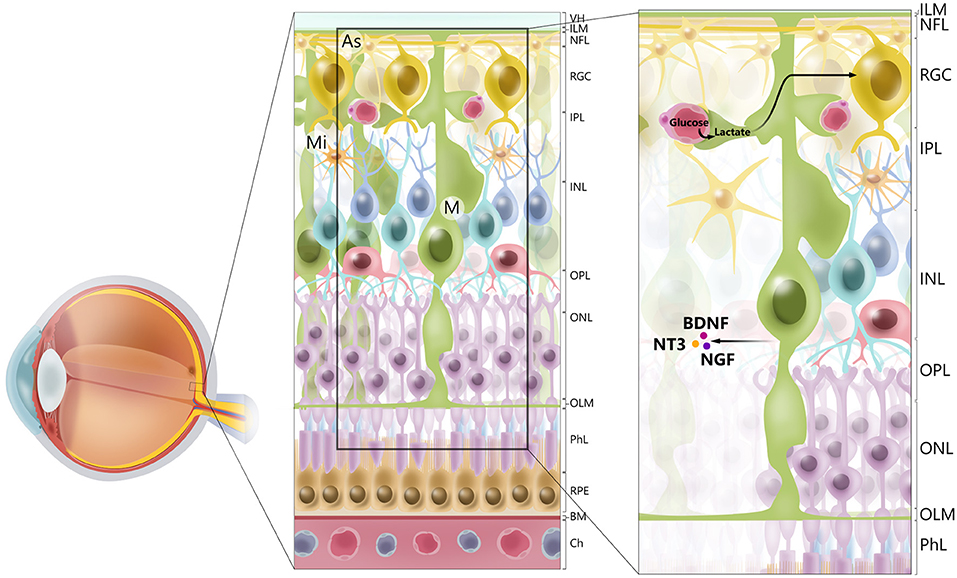
- Müller cells : stand like pillars through the retina
- Neuroglial cells : fill the spaces between the nerve cells and support them
Müller cells are the main and most common glial cells of the retina. Each is a long cell whose cell body lies in the inner nuclear layer and whose processes span almost the whole thickness of the neural retina: outwards to the outer limiting membrane at the bases of the rods and cones, and inwards to the inner limiting membrane, which is formed by their expanded end-feet. Their branches fill the spaces between the neurons, like the pillars and walls of a building. They keep the surroundings of the retinal neurons stable: they take up neurotransmitters, regulate potassium, store glycogen, remove debris and insulate neurons from each other. They also give the retina mechanical support and may help guide light through it to the photoreceptors. Together with astrocytes and microglia they form the glia of the retina; they are glial cells of nervous tissue, not connective tissue cells.
Reference websites
[Wikipedia]
· Müller glia, Wikipedia.
[Websites with illustrations]
· Müller glial cell and its contacts with neurons and microglia (Nature Reviews Neuroscience)

· Layers of the retina with a Müller cell spanning them (Frontiers in Neurology)
Related terms
- Cell body
- Microglia
- Retina
- Glial cell
- Neuroglia
- Astrocyte
- Ganglion cell layer
- Optic part of retina
- Retinal pigment epithelium
References and sources
- Further reading: Müller glia, Wikipedia.
- Federative International Programme for Anatomical Terminology (FIPAT). Terminologia Anatomica, 2nd ed. (TA2), 2019.