Cell body
Also called the soma or the perikaryon
of a
neuron
- Cell body : the enlarged part holding the nucleus, mitochondria and other organelles.
- Processes
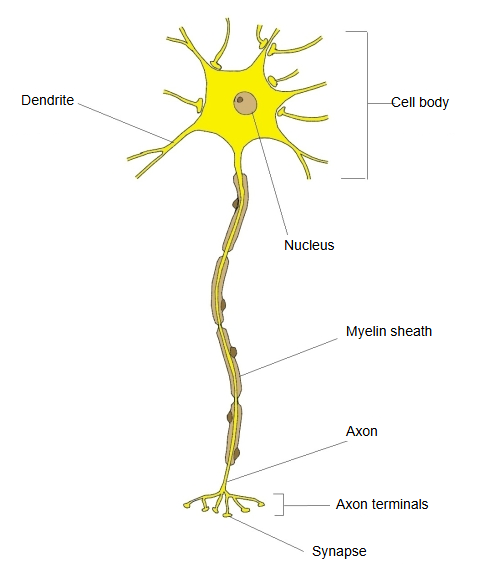
Typical sizes of the cell body by type of neuron (rough figures; sources differ):
| Type of neuron | Size of the cell body | |
|---|---|---|
| 1 | Small neurons (e.g. small interneurons) | about 5–15 µm |
| 2 | Pseudounipolar neurons (e.g. in the dorsal root ganglia and other sensory ganglia) | about 20–100 µm |
| 3 | Motor neurons (anterior horn cells of the spinal cord) | about 20–60 µm |
| 4 | Pyramidal cells (cerebral cortex) | about 10–50 µm |
| 5 | Purkinje cells (cerebellar cortex) | about 50–80 µm (very large) |
| 6 | Giant cells (e.g. Betz cells, giant pyramidal cells of the motor cortex) | may exceed 100 µm |
Functions of the cell body
[Keeping the cell alive (centre of metabolism)]
It holds the nucleus and the organelles (ribosomes, mitochondria and others), and carries out protein synthesis and energy production for the whole neuron.
[Integrating information]
It gathers the electrical signals (postsynaptic potentials) that arrive from the dendrites and from synapses on its own membrane, and so decides whether the neuron finally fires.
[Maintaining and repairing the processes]
It supplies the proteins and energy needed for the growth, maintenance and repair of the dendrites and the axon.
[Part of signal conduction]
Electrical signals spread over the short distance across the membrane of the cell body to the axon hillock (the start of the axon), where the decision to fire is made.
Structure inside the cell body:
Its cytoskeleton contains many neurofilaments, a kind of intermediate filament, and neurotubules (microtubules), which run on into the dendrites and the axon and carry materials between them and the cell body. The nucleus often has a large nucleolus. Around the nucleus lie clumps of rough endoplasmic reticulum, the Nissl substance, which stains with Nissl stains; they show that the cell body makes proteins actively.
Cell bodies gather in the gray matter of the brain and spinal cord and in ganglia. Sources differ on the word "perikaryon": some use it for the whole cell body, others only for the cytoplasm around the nucleus.
A short dictionary definition (Dictionary.com):
"the compact area of a nerve cell that constitutes the nucleus and surrounding cytoplasm, excluding the axons and dendrites."
Reference websites
[Wikipedia]
· Soma (biology), Wikipedia.
· Neuron, Wikipedia.
[Websites with illustrations]
· Neuron cell body (diagram) (Wikimedia Commons)

· Neuron (diagram) (cosbiology.pbworks.com)

· Complete neuron cell diagram (humanphysiology.academy)

Related terms
- Cytoplasm
- Müller cell
- Dendrite
- Axon
- Axon hillock
- Pseudounipolar neuron
- Glial cell
- Gray matter
- Nervous tissue
References and sources
- Further reading: Soma (biology), Wikipedia.
- Further reading: Neuron, Wikipedia.
- Federative International Programme for Anatomical Terminology (FIPAT). Terminologia Anatomica, 2nd ed. (TA2), 2019.