Pre-osteoblast
Also called the preosteoblast or the osteoprogenitor cell
Overview
From stem cell to osteocyte
Osteoblasts work at the bone surface, especially at sites of remodelling.
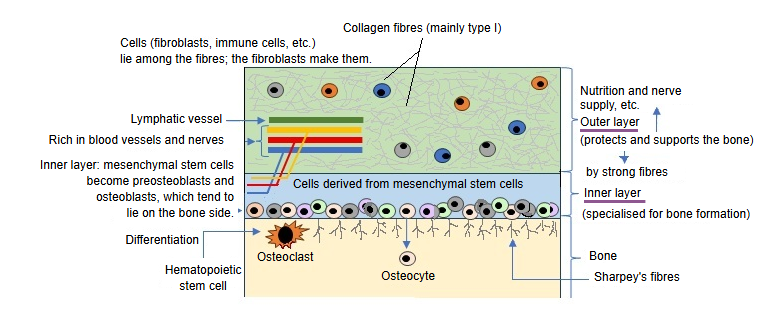
The figure below is a diagram of the structure of the periosteum. In the periosteum the pre-osteoblasts lie in a row in the inner layer, close to the bone.
Main features
1. 1. Not yet specialized, but already committed to making bone. Differentiation from the mesenchymal stem cell has gone far enough that the cell is set on the bone-forming line. Sources differ on whether 'osteoprogenitor cell' and 'pre-osteoblast' name the same stage.
2. Weaker in function than the mature osteoblast:
it starts to make (type I) collagen, but only a little;
it shows a moderate level of alkaline phosphatase (ALP);
it cannot yet mineralize the bone matrix well.
3. 3. It divides actively. Mature osteoblasts divide little, but pre-osteoblasts multiply readily. They are usually at rest and start dividing and differentiating again when new bone is needed.
Where is it found? Mainly in the cell layer (cambium layer) of the periosteum and the endosteum on the bone surfaces. It is also numerous:
where the callus forms during the healing of a fracture;
on the bone-forming surfaces of remodelling sites (near the osteoid seams).
Related terms
- Osteoblast
- Osteocyte
- Mesenchymal stem cell
- Periosteum
- Endosteum
- Cell layer of periosteum
- Osteoblastic niche
References and sources
- Further reading: Osteoblast, Wikipedia.
- Federative International Programme for Anatomical Terminology (FIPAT). Terminologia Anatomica, 2nd ed. (TA2), 2019.