Osteocyte (Latin: osteocytus)
Also called the bone cell
- Osteoblast: secretes bone matrix and forms bone; becomes an osteocyte
- Osteocyte: the most numerous cell in bone; osteocytes are linked to one another
- Osteoclast: breaks down (resorbs) bone
From stem cell to osteocyte
Osteocytes can live for decades. Some die by apoptosis with age or injury, and old bone with its osteocytes is removed by osteoclasts and replaced during remodelling. Sources differ on the names of the intermediate cells between the stem cell and the pre-osteoblast.
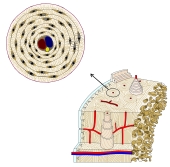 Osteon (cross section)
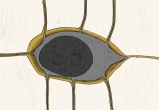 Osteocyte in its lacuna
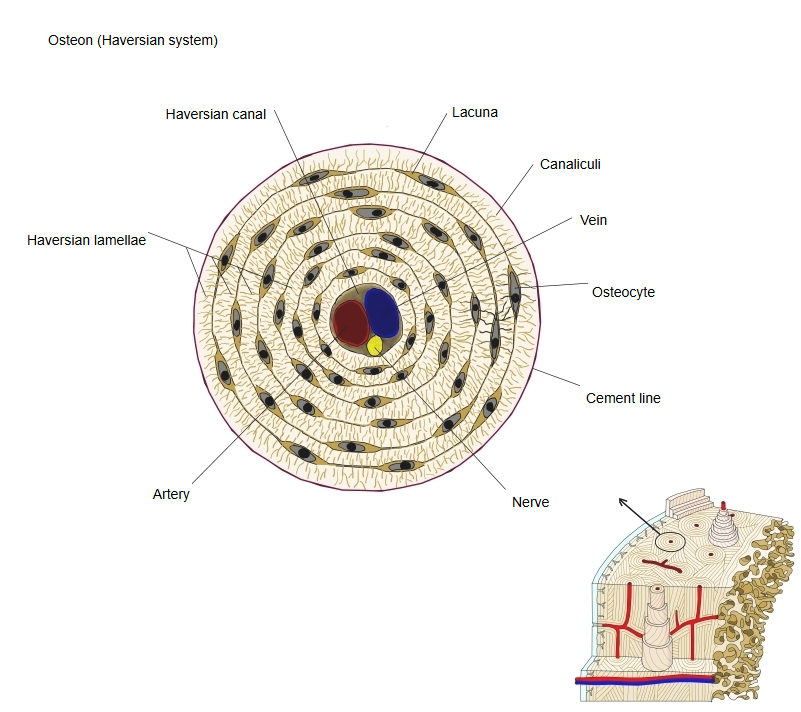
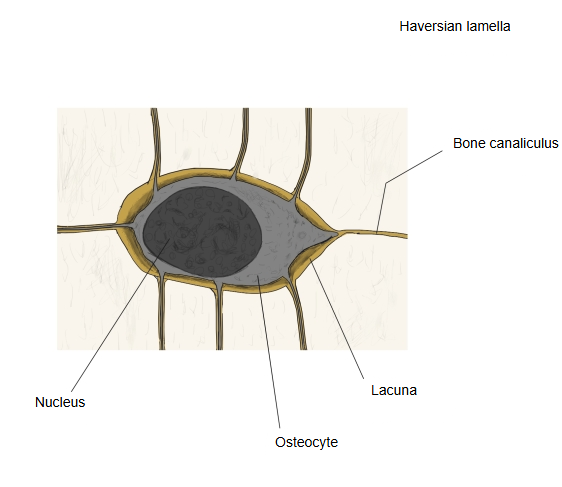
· The cell has a nucleus covered by a thin layer of cytoplasm.
· Long, thin processes of the cytoplasm run through the canaliculi and meet the processes of neighbouring osteocytes at gap junctions. Nutrients and wastes pass along this network.
· Osteocytes make little new matrix and do not divide, but they are far from idle: they sense mechanical load through several mechanosensitive mechanisms, exchange signals with one another, and help direct bone remodelling by osteoblasts and osteoclasts.
· Osteocytes can also remove small amounts of matrix around themselves (osteocytic osteolysis), a faster and more local process than resorption by osteoclasts.
Reference websites
[Wikipedia]
· Osteocyte, Wikipedia.
Video
Related terms
References and sources
- Further reading: Osteocyte, Wikipedia.
- Federative International Programme for Anatomical Terminology (FIPAT). Terminologia Anatomica, 2nd ed. (TA2), 2019.