Bronchoesophageal muscle (Latin: musculus bronchooesophageus)
Also called the broncho-oesophageus
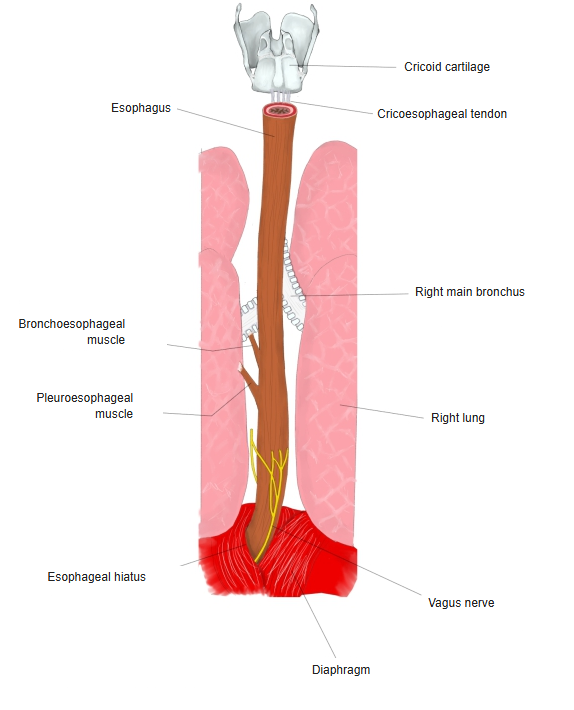
Small slips of smooth muscle that join the outer longitudinal layer of the thoracic esophagus to the posterior wall of the left main bronchus. It is one of the accessory bundles of the esophageal muscle in the thorax, where the esophagus passes behind the left main bronchus (bronchi); a similar slip to the left mediastinal pleura is the pleuroesophageal muscle, and higher up the longitudinal muscle is anchored to the cricoid cartilage by the cricoesophageal tendon. It helps to tie the esophagus to the airway in the posterior mediastinum. It is small and inconstant; sources differ on how often it is present and how it is described.
See the outer longitudinal muscle layer on the Esophagus page.
Related terms
References and sources
- Further reading: Esophagus, Wikipedia.
- Federative International Programme for Anatomical Terminology (FIPAT). Terminologia Anatomica, 2nd ed. (TA2), 2019.