Internal anal sphincter (Latin: musculus sphincter ani internus)
The internal anal sphincter is
The external anal sphincter, which lies outside it, is striated muscle (skeletal muscle under voluntary control).
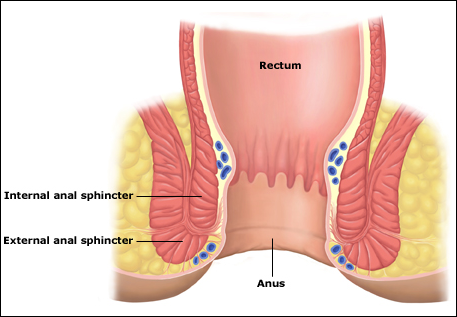
The internal anal sphincter is a ring of muscle that runs round the gut in the anal canal, the last part of the large intestine, which follows the rectum and ends at the anus. It surrounds about the upper 2.5–4 cm of the canal, is about 5 mm thick, and its lower edge lies a little above the anal opening. It is smooth muscle, an involuntary muscle controlled by the autonomic nerves: sympathetic fibres maintain its contraction and parasympathetic fibres relax it. It is not supplied by the pudendal nerve, which supplies the external sphincter. It stays contracted most of the time and keeps the anus closed when a person is not defecating; it provides most of the resting pressure of the canal and is important for holding gas and liquid. When the rectum fills, it relaxes by reflex (the rectoanal inhibitory reflex); continence then depends on voluntary contraction of the external sphincter and puborectalis. The anal sphincters are this muscle and, outside it, the external anal sphincter; the two are separated by the conjoint longitudinal muscle, and their lower edges meet at the intersphincteric groove.
In the anal canal, the inner circular layer (the circular muscle layer) of the smooth muscle of the gut wall is especially well developed and thick; this thickening is the internal anal sphincter.
Reference websites
[Wikipedia]
· Internal anal sphincter, Wikipedia.
[Websites with illustrations]
· Coronal section of rectum and anal canal (Gray's Anatomy) (Wikimedia Commons)

· Internal and external anal sphincters (section) (Blogger)
Related terms
- Anal sphincter
- External anal sphincter
- Anal canal
- Conjoint longitudinal muscle
- Intersphincteric groove
- Smooth muscle
- Rectum
References and sources
- Further reading: Internal anal sphincter, Wikipedia.
- Federative International Programme for Anatomical Terminology (FIPAT). Terminologia Anatomica, 2nd ed. (TA2), 2019.