Cribriform fascia (Latin: fascia cribrosa)
Also called Hesselbach's fascia
The cribriform fascia is the thin sheet of fascia that covers the saphenous opening and is pierced by many small holes through which blood vessels and nerves pass.
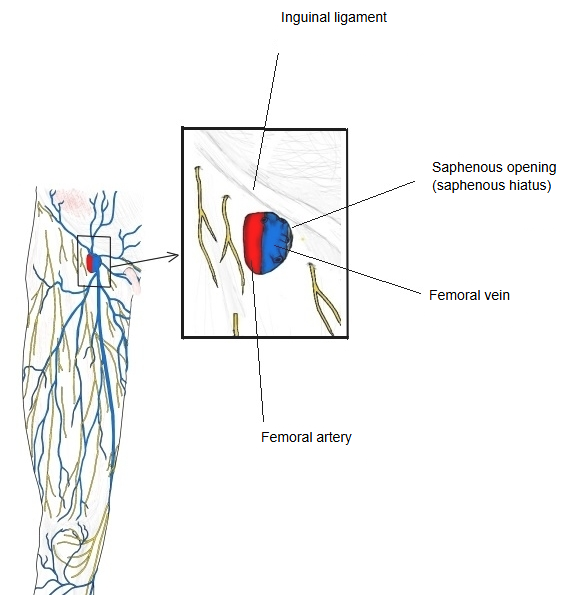
Saphenous opening: an oval gap in the fascia lata in the femoral triangleVessels: for example the great saphenous vein and the superficial epigastric artery
 Saphenous opening: details
 Saphenous opening
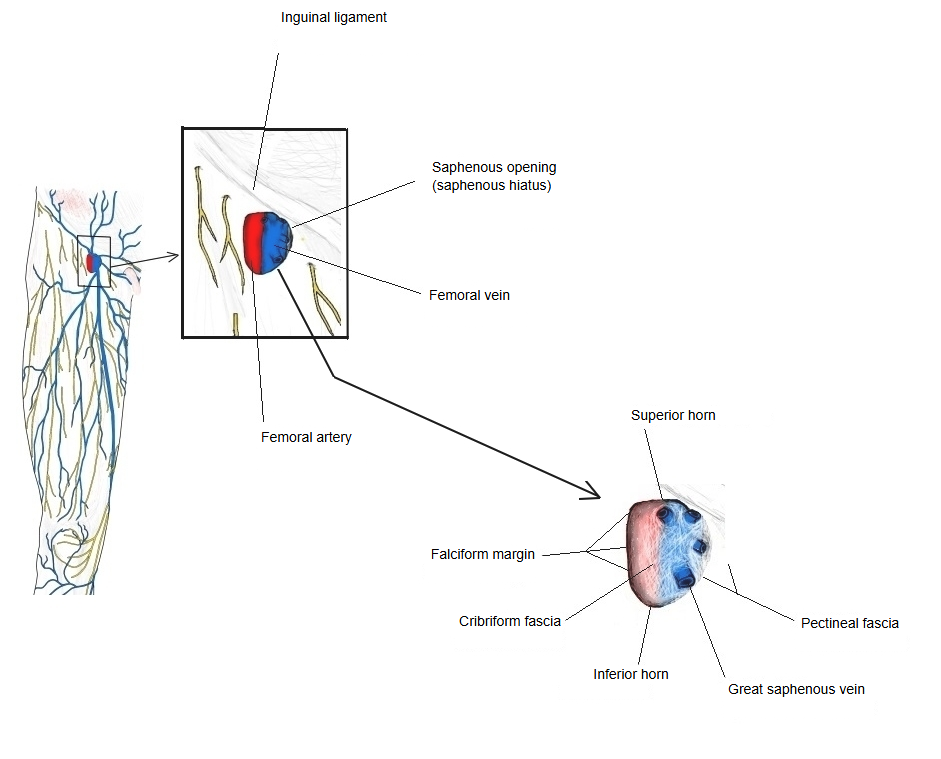
Structures passing through the cribriform fascia into the saphenous opening
The list below may not include every structure that passes through.
The saphenous opening is closed by the thin cribriform fascia, which is continuous with the falciform margin, the fascia lata and the pectineal fascia; its many holes let vessels and nerves through. Its name comes from Latin cribrum, a sieve. The structures usually listed are:
| 1 | Blood vessels | Great saphenous vein, superficial epigastric artery, superficial external pudendal artery (and their veins) |
| 2 | Nerve | Femoral branch of the genitofemoral nerve (sources differ: it may pierce the fascia lata nearby instead) |
| 3 | Other | Lymph vessels running to the deep inguinal lymph nodes |
Reference websites
[Wikipedia]
· Cribriform fascia, Wikipedia.
· Saphenous opening, Wikipedia.
[Websites with illustrations]
· Saphenous opening and cribriform fascia (Basicmedical Key)
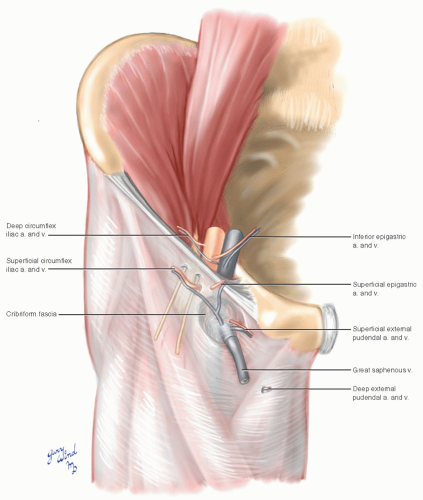
· Saphenous opening (video still) (YouTube)

· Fascia of the thigh (slide) (SlideServe)
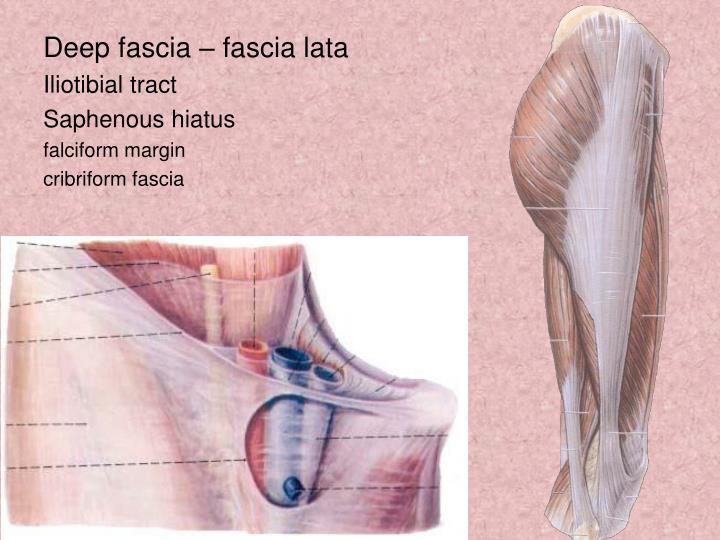
Related terms
References and sources
- Further reading: Cribriform fascia, Wikipedia.
- Federative International Programme for Anatomical Terminology (FIPAT). Terminologia Anatomica, 2nd ed. (TA2), 2019.