Fascia lata (Latin: fascia lata)
What is the fascia lata?
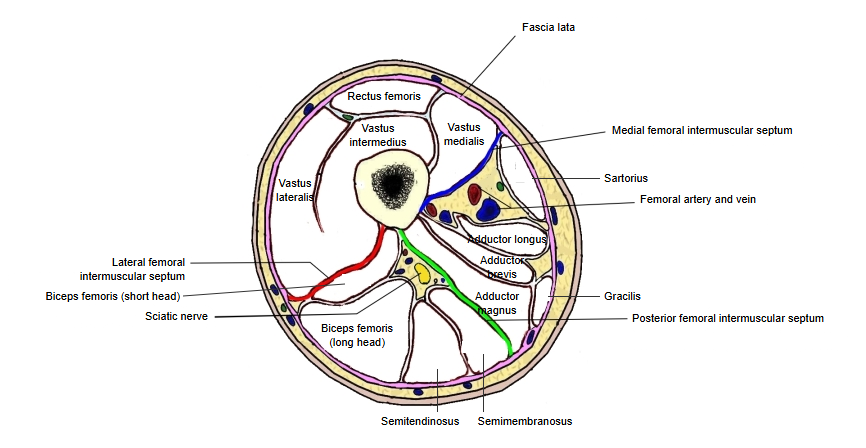
It is the deep fascia that wraps the thigh muscles like a sleeve; above, it is continuous with the inguinal ligament. From its deep surface it sends sheets of connective tissue inward between the muscle groups, forming the intermuscular septa: the medial and lateral femoral intermuscular septa, attached to the linea aspera of the femur, and a thinner posterior septum.
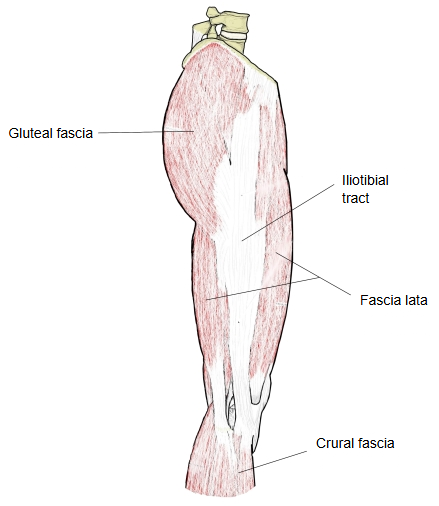
· Above, it is attached to the inguinal ligament, the pubis, the ischium, the iliac crest and the back of the sacrum and coccyx; below, it blends with the fascia around the knee and continues as the crural fascia.
· It is thickest on the lateral side, where it forms the iliotibial tract, which receives the tensor fasciae latae and most of the gluteus maximus and runs to the lateral condyle of the tibia.
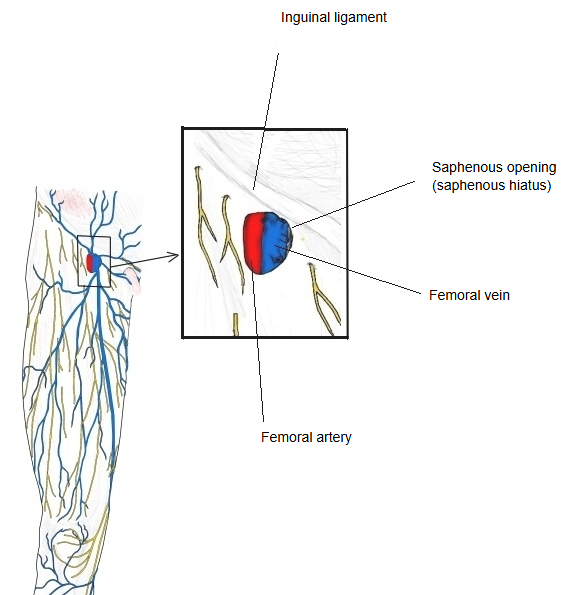
· It is thin over the adductors on the upper medial side, where the saphenous opening lets the great saphenous vein pass through to the femoral vein. The septa divide the thigh into anterior, medial and posterior compartments.
The following nine structures are often listed as related to the fascia lata:
1. 1. Medial femoral intermuscular septum 2. Lateral femoral intermuscular septum 3. Posterior intermuscular septum of the thigh 4. Iliotibial tract 5. Pectineal fascia
6. 6. Saphenous opening 7. Femoral triangle 8. Femoral canal 9. Femoral ring
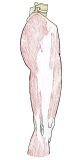 Right thigh (lateral view)
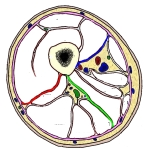 Left thigh (cross-section)
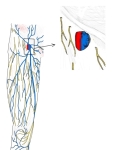 Saphenous opening
Reference websites
[Wikipedia]
· Fascia lata, Wikipedia.
· Iliotibial tract, Wikipedia.
[Websites with illustrations]
· Fascia lata: anatomy and blood supply (Kenhub)
· Fascia lata on the lateral thigh (dissection image) (Outlander Anatomy)

Related terms
- Femoral intermuscular septa
- Fascia
- Saphenous opening
- Femoral triangle
- Tensor fasciae latae
- Gluteus maximus
- Inguinal ligament
- Linea aspera
References and sources
- Further reading: Fascia lata, Wikipedia.
- Further reading: Iliotibial tract, Wikipedia.
- Federative International Programme for Anatomical Terminology (FIPAT). Terminologia Anatomica, 2nd ed. (TA2), 2019.