Anterior tubercle of atlas (Latin: tuberculum anterius atlantis)
A small elevation on the front of the anterior arch of the atlas, where longus colli and the anterior longitudinal ligament are attached.
The 2nd and lower cervical vertebrae also have an "anterior tubercle", but in a quite different place (the front end of the transverse process); do not confuse the two.
It is described as projecting slightly downwards.
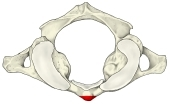 Atlas, superior view
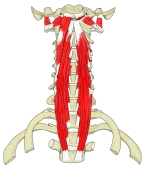 Prevertebral muscles
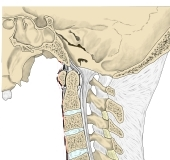 Median section
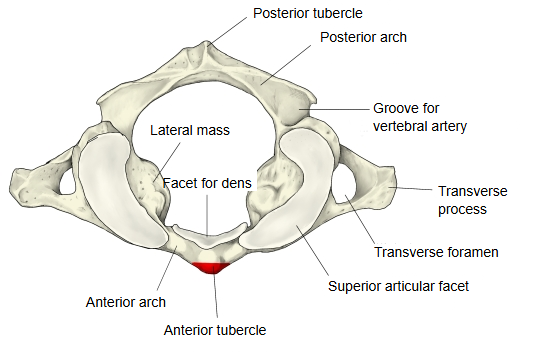
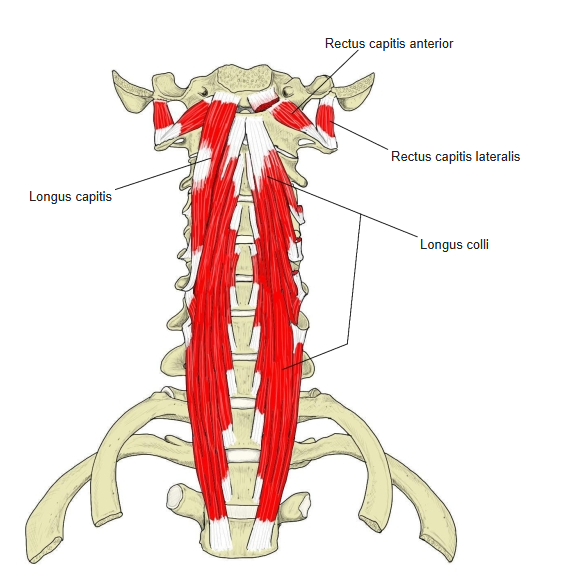
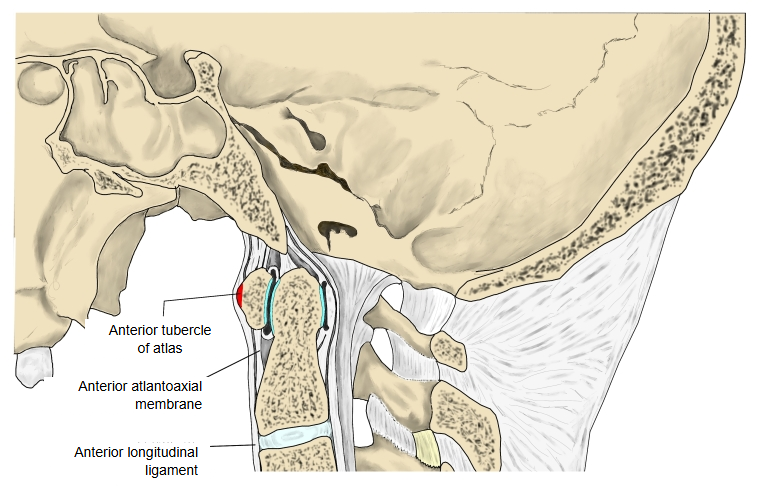
The anterior arch forms about one fifth of the ring of the atlas. Its front surface is convex and carries the anterior tubercle at its centre, for longus colli and the anterior longitudinal ligament; its back surface is concave and bears a smooth oval facet (the facet for the dens) that articulates with the dens of the axis.
Reference websites
[Wikipedia]
· Atlas (anatomy), Wikipedia.
[Websites with illustrations]
· First cervical vertebra, or atlas (Gray's Anatomy, fig. 86) (Wikimedia Commons)

· Cervical spine: anatomy, ligaments, nerves and injury (Kenhub)
Related terms
- Anterior arch of atlas
- Posterior arch of atlas
- Lateral mass of atlas
- Superior articular facet of atlas
- Atlas
References and sources
- Further reading: Atlas (anatomy), Wikipedia.
- Federative International Programme for Anatomical Terminology (FIPAT). Terminologia Anatomica, 2nd ed. (TA2), 2019.