Dorsum of tongue (Latin: dorsum linguae)
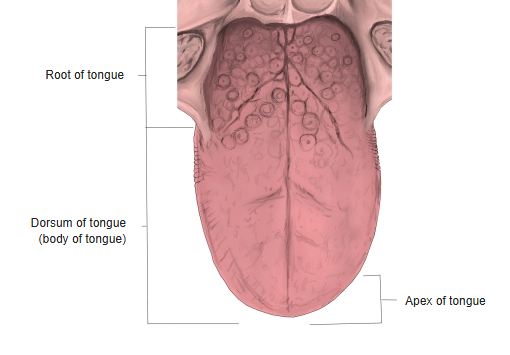
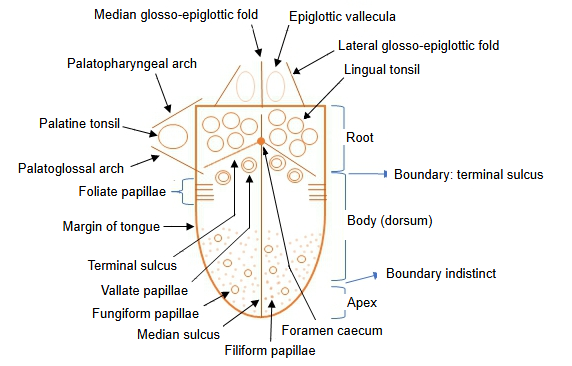
The front end of the tongue is called the apex; there is no clear boundary between the apex and the dorsum behind it.
The back part of the tongue is called the root; between the dorsum and the root there is a clear boundary, the terminal sulcus.
The upper surface in front of the sulcus is rough with the lingual papillae and is divided in the midline by the median sulcus; the surface behind the sulcus bears the lingual tonsil. Sources differ: some texts, and the three-part division on this page (definition and diagram), treat the dorsum and the body of the tongue as the same thing, but in Terminologia Anatomica the dorsum is the whole upper surface of the tongue, over both the body and the root.
of the
tongue
- Oral part : the front two-thirds
- Apex : the front part of the tongue (its tip). There is no clear boundary with the dorsum.
- Dorsum : the middle part of the tongue, also called the body of the tongue.
- Pharyngeal part : the back third; the terminal sulcus marks a clear boundary with the oral part
- Root : the back part and base of the tongue.
In this textbook description the front of the tongue is the apex, the middle is the dorsum (the body) and the back is the root. The boundary between the apex and the dorsum is not distinct, but the boundary between the dorsum and the root is clearly marked by the terminal sulcus. The apex and the dorsum make up the front two-thirds of the tongue (the oral part); the root makes up the back third (the pharyngeal part).
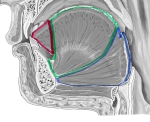 Tongue (median section)
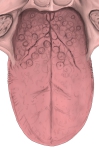 Tongue (from above)
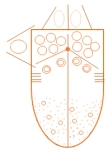 Tongue (diagram)
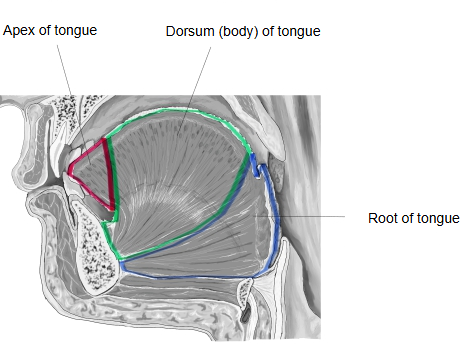
Related terms
- Apex of tongue
- Body of tongue
- Root of tongue
- Terminal sulcus of tongue
- Median sulcus of tongue
- Lingual papillae
- Tongue
References and sources
- Further reading: Tongue, Wikipedia.
- Federative International Programme for Anatomical Terminology (FIPAT). Terminologia Anatomica, 2nd ed. (TA2), 2019.