Terminal sulcus of tongue (Latin: sulcus terminalis linguae)
· Behind, the groove ends in a small pit, the foramen caecum, about 2.5 cm in front of the back end of the tongue (as described in Gray's Anatomy).
The groove is V-shaped: its apex points backward to the foramen caecum, and from there each limb runs forward and laterally toward the margin of the tongue. It divides the body of the tongue (the oral part, front two-thirds) from the root (the pharyngeal part, back third).
Behind the groove the root of the tongue carries the lingual tonsil; in front of it lie the fungiform and filiform papillae of the body, and the foliate papillae on the margins near its ends.
It reflects development: the front two-thirds and the back third of the tongue come from different pharyngeal arches, so their sensory nerves differ. Not to be confused with the sulcus terminalis of the heart, a groove on the right atrium.
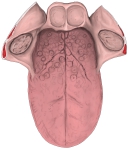 Tongue and epiglottis from above
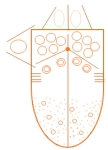 Tongue (diagram)
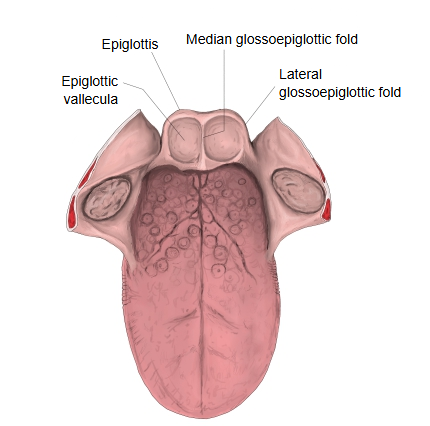
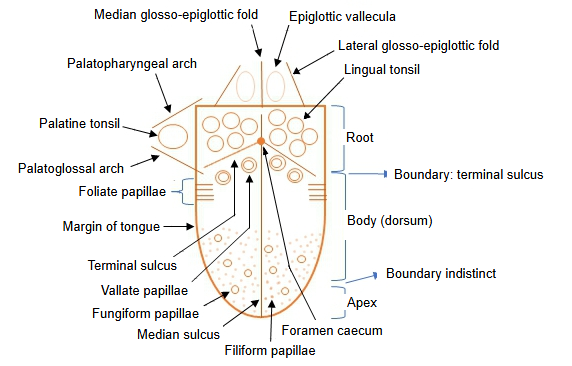
Reference websites
[Wikipedia]
· Terminal sulcus (tongue), Wikipedia.
· Tongue, Wikipedia.
[Websites with illustrations]
· Tongue: anatomy, muscles, neurovasculature and histology (Kenhub)
· The oral cavity (TeachMeAnatomy)
Related terms
- Tongue
- Vallate papillae
- Foliate papillae
- Lingual tonsil
- Epiglottic vallecula
- Fungiform papillae
- Filiform papillae
References and sources
- Further reading: Terminal sulcus (tongue), Wikipedia.
- Further reading: Tongue, Wikipedia.
- Federative International Programme for Anatomical Terminology (FIPAT). Terminologia Anatomica, 2nd ed. (TA2), 2019.