Apex of tongue (Latin: apex linguae)
Also called the tip of the tongue
· The central part of the tongue behind the apex is called the dorsum of the tongue; there is no clear boundary between the apex and the dorsum.
· The apex and the dorsum together take up the front two-thirds of the tongue and are also called the oral part of the tongue.
When the mouth is closed the apex rests against the back of the incisor teeth. It is the most mobile part of the tongue and is important in speech, in moving food and in touch and taste. Lymph from the apex drains mainly to the submental lymph nodes. See also the margin, the inferior surface with the lingual frenulum, and the median sulcus over the lingual septum.
of the
tongue
- Oral part : the front two-thirds
- Apex : the front part of the tongue (its tip). There is no clear boundary with the dorsum.
- Dorsum : the middle part of the tongue, also called the body of the tongue.
- Pharyngeal part : the back third; the terminal sulcus marks a clear boundary with the oral part
- Root : the back part and base of the tongue.
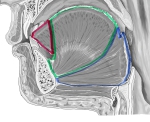 Tongue (median section)
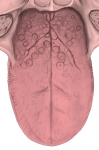 Tongue (from above)
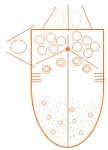 Tongue (diagram)
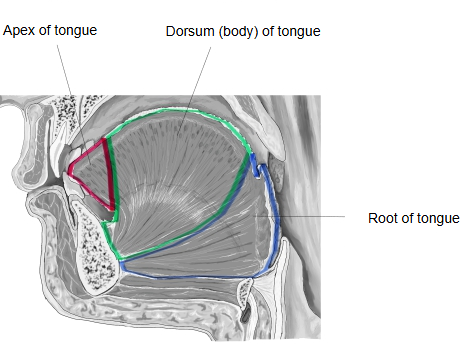
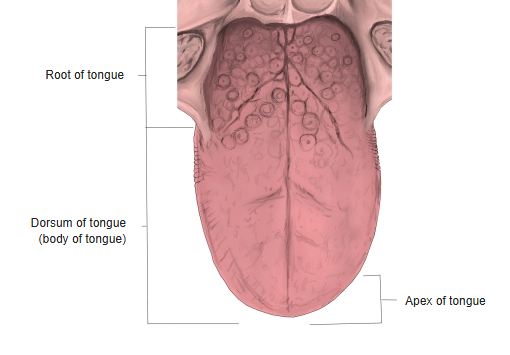
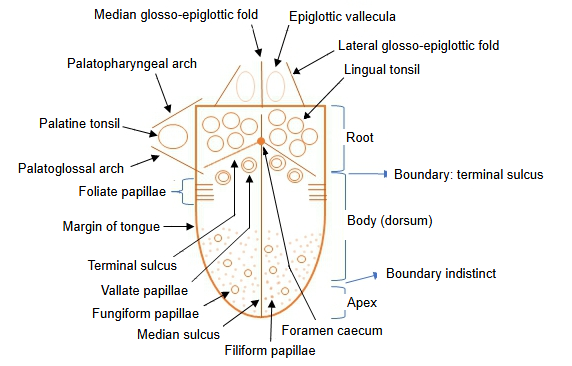
In this textbook description the front of the tongue is the apex, the middle is the dorsum (the body) and the back is the root. The boundary between the apex and the dorsum is not distinct, but the boundary between the dorsum and the root is clearly marked by the terminal sulcus. The apex and the dorsum make up the front two-thirds of the tongue (the oral part); the root makes up the back third (the pharyngeal part).
Related terms
- Root of tongue
- Margin of tongue
- Inferior surface of tongue
- Median sulcus of tongue
- Lingual septum
- Median glosso-epiglottic fold
- Tongue
- Terminal sulcus of tongue
- Lingual frenulum
- Lingual papillae
- Fungiform papillae
- Extrinsic muscles of tongue
References and sources
- Further reading: Tongue, Wikipedia.
- Federative International Programme for Anatomical Terminology (FIPAT). Terminologia Anatomica, 2nd ed. (TA2), 2019.