Median sulcus of tongue (Latin: sulcus medianus linguae)
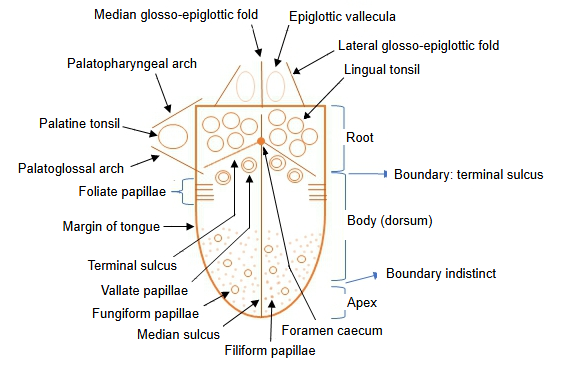
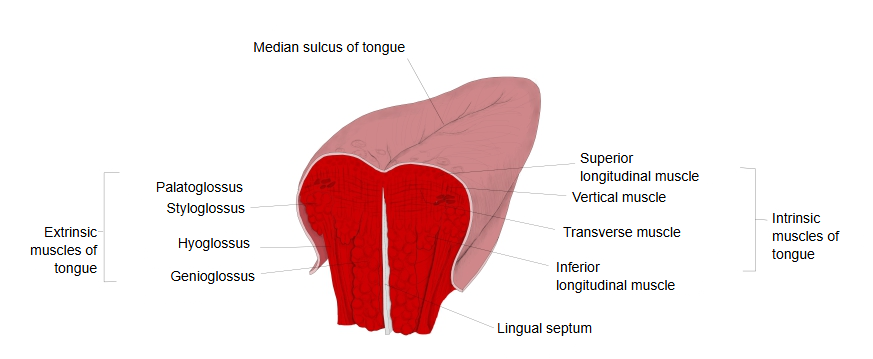
· The median sulcus is produced by the lingual septum inside the tongue.
The lingual septum is a firm sheet of connective tissue that runs in the midline through the inside of the body of the tongue; the median sulcus is the shallow dent it leaves on the surface. The septum does not reach all the way up to the dorsum of the tongue.
· At its back end lies the foramen caecum, at the apex of the V-shaped terminal sulcus. The groove reflects development: the front part of the tongue forms from paired swellings that fuse in the midline.
 Tongue and epiglottis from above
 Tongue (diagram)
 Tongue (coronal section)

Reference websites
[Wikipedia]
· Tongue, Wikipedia.
· Lingual septum, Wikipedia.
[Websites with illustrations]
· Structure of the tongue (figure) (Kenhub)

· Dorsum of the tongue with the median sulcus (figure) (Springer Nature)

Related terms
- Root of tongue
- Apex of tongue
- Margin of tongue
- Inferior surface of tongue
- Lingual septum
- Median glosso-epiglottic fold
- Tongue
- Terminal sulcus of tongue
- Lingual papillae
- Filiform papillae
- Fungiform papillae
- Vallate papillae
- Lingual tonsil
References and sources
- Further reading: Tongue, Wikipedia.
- Further reading: Lingual septum, Wikipedia.
- Federative International Programme for Anatomical Terminology (FIPAT). Terminologia Anatomica, 2nd ed. (TA2), 2019.