Lumbar triangle (Latin: trigonum lumbale)
Also called the inferior lumbar triangle or Petit's triangle.
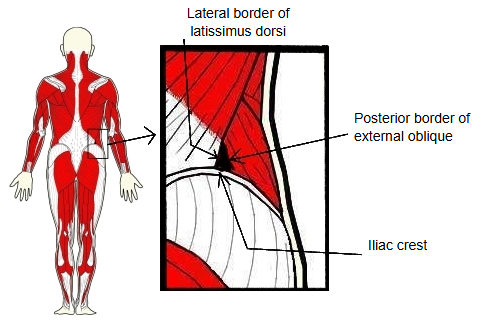
· The floor of the triangular gap is formed by internal oblique; it is covered only by superficial fascia and skin. The size of the gap varies, and in some people the two muscles overlap so that there is no triangle.
· Wikipedia and many other sources divide it into a superior lumbar triangle and an inferior lumbar triangle; the lumbar triangle described here is the inferior one.
Boundaries of the superior lumbar triangle: quadratus lumborum, internal oblique and the twelfth rib.
⇒ An illustration showing the superior and inferior lumbar triangles (Radiopaedia)
 Lumbar triangle
 Muscles of the back
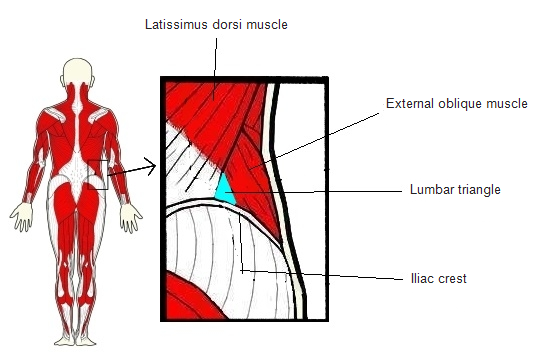
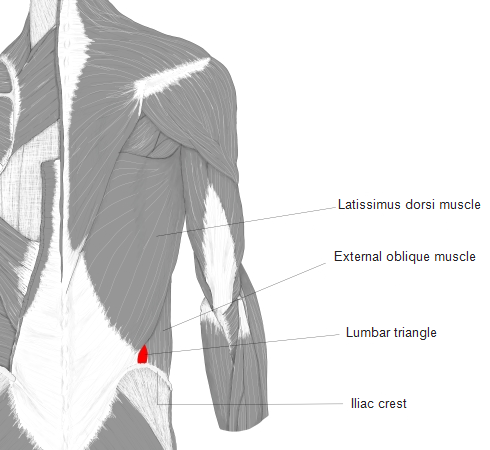

The term lumbar triangle can mean either the inferior lumbar triangle, which lies superficially, or the superior lumbar triangle, which lies deeper and higher up. The superior triangle is larger, is found more consistently and is the more common site of lumbar hernia, but the plain term usually means the inferior triangle, which is superficial and easier to show.
Inferior lumbar triangle (Petit's triangle)
Bounded below by the iliac crest, behind by the anterolateral border of latissimus dorsi and in front by the posterior border of external oblique. Its floor is internal oblique. It is a weak area of the posterior abdominal wall; a lumbar hernia through it is called a Petit's hernia, which is rare.
Superior lumbar triangle (Grynfeltt–Lesshaft triangle)
Bounded above by the twelfth rib (and the lower border of serratus posterior inferior), medially by quadratus lumborum and the erector spinae, and laterally by the posterior border of internal oblique. Its floor is the aponeurosis of transversus abdominis (which joins the thoracolumbar fascia behind) with the transversalis fascia on its inner side, and it is covered by latissimus dorsi. A lumbar hernia through it is called a Grynfeltt (Grynfeltt–Lesshaft) hernia.
Reference websites
[Wikipedia]
· Lumbar triangle, Wikipedia.
· Petit's hernia, Wikipedia.
· Grynfeltt–Lesshaft hernia, Wikipedia.
[Websites with illustrations]
· Posterior view of the back muscles with the lumbar triangle (Wikimedia Commons)

· Superior and inferior lumbar triangles (illustration) (Radiopaedia)
Related terms
- Latissimus dorsi
- External oblique
- Internal oblique
- Iliac crest
- Thoracolumbar fascia
- Quadratus lumborum
References and sources
- Further reading: Lumbar triangle, Wikipedia.
- Federative International Programme for Anatomical Terminology (FIPAT). Terminologia Anatomica, 2nd ed. (TA2), 2019.