Twelfth rib (Latin: costa duodecima)
Also called: rib XII
The main features of the twelfth rib are listed below.
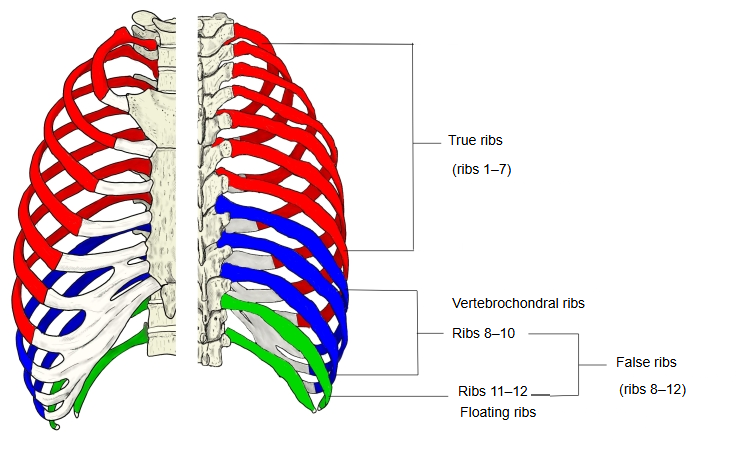
The ribs are divided into true ribs and false ribs; the twelfth rib is the lowest of the five false ribs. Its front end does not join the sternum or the ribs above but ends freely between the muscles of the abdominal wall, so it is called a floating rib.
- True ribs : 1st, 2nd, 3rd, 4th, 5th, 6th and 7th ribs
- False ribs
- Vertebrochondral ribs : 8th, 9th and 10th ribs
- Floating ribs : 11th rib, 12th rib
The features of each rib are compared on the Ribs page.
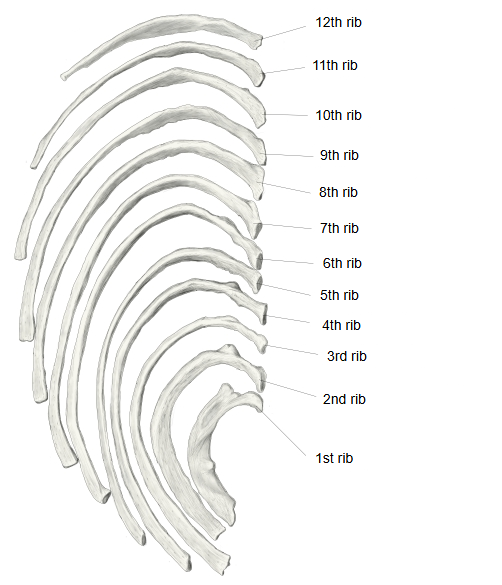
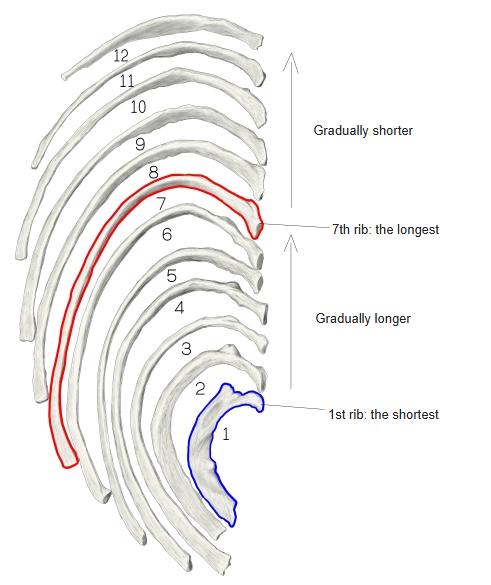
Of the 12 pairs of ribs, the 3rd to 9th have the typical shape (the 10th differs only in having a single facet on its head); the four ribs listed below differ most, and the twelfth rib is one of them. Its head has a single facet for the body of the twelfth thoracic vertebra, and it has no neck, no tubercle, no angle and hardly any costal groove. It is usually the shortest rib, but its length varies.
the typical shape
- 1st rib : very short, broad and strongly curved; flattened from above downward.
- 2nd rib : the tubercle and the angle are at the same place.
- 11th rib : no tubercle and only a slight angle.
- 12th rib : neither a tubercle nor an angle.
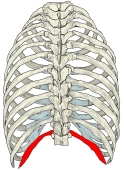 Thorax (back)
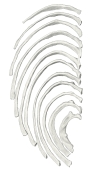 Right ribs (superior view)
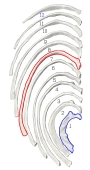 Right ribs (superior view)
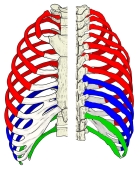 True ribs and false ribs
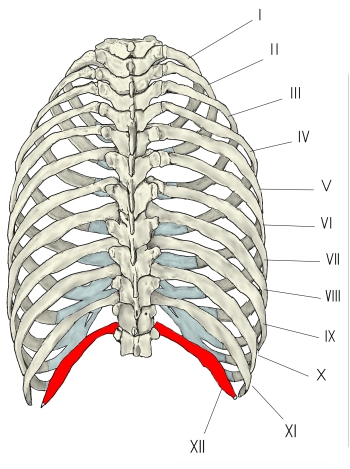
■ Attachments ■
The muscles and ligaments attached to the twelfth rib are listed below; the list may not be complete. The ligaments are divided into those attached to the bony rib (costal bone) and those attached to the costal cartilage; whether the latter should count as ligaments of the rib is open to debate. Besides the muscles in the table, the diaphragm, the abdominal muscles, the serratus posterior inferior and the latissimus dorsi are also attached to the twelfth rib.
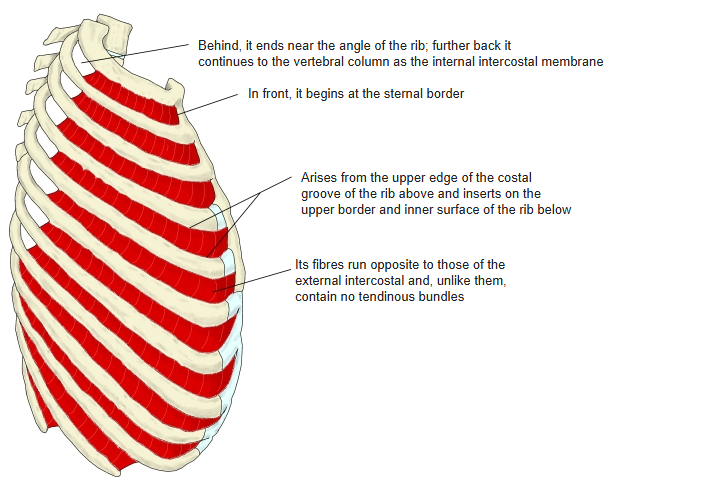
| Muscles | Insertion (from the 11th rib) | 1 | Internal intercostal muscles | (from the edge of the costal groove of the 11th rib to the upper border of the body of the 12th rib) |
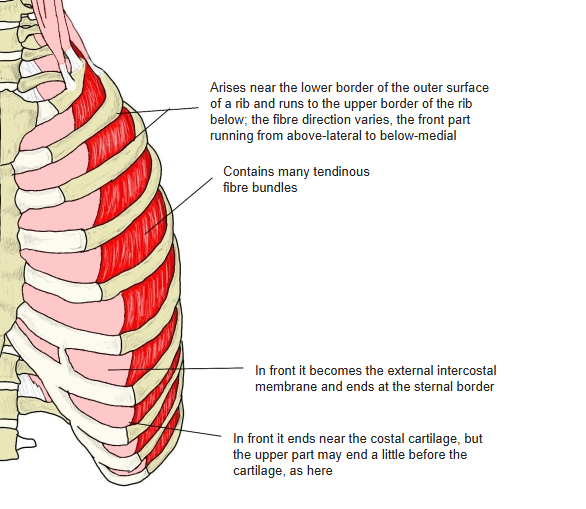
| 2 | External intercostal muscles | (from the lower border of the 11th rib to the upper border of the outer surface of the 12th rib) | ||
| 3 | Innermost intercostal muscles | (not always present) | ||
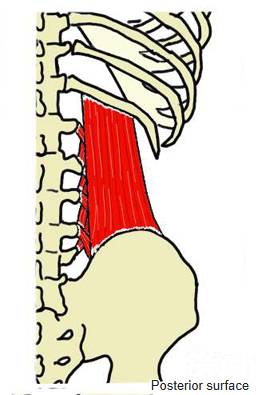
| Insertion | 1 | Quadratus lumborum | 12th rib (lower border of the body) and transverse processes of L1-L4 ⇔ iliac crest and iliolumbar ligament | |
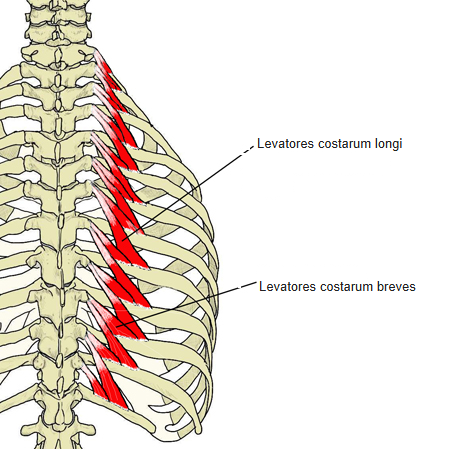
| 2 | Levatores costarum | all ribs (outer surface near the back; on the 12th rib close to the head) ⇔ transverse processes of C7 and T1-T11 | ||
| Ligaments | Bony rib | 1 | Radiate ligament of head of rib | rib (head) ⇔ thoracic vertebrae (vertebral body and intervertebral disc) |
| 2 | Costotransverse ligament | rib (back of the end next to the head) ⇔ thoracic vertebra (transverse process); rudimentary at the 12th rib | ||
| 3 | Superior costotransverse ligament | rib (upper border near the head) ⇔ thoracic vertebra above (transverse process) | ||
| 4 | Lateral costotransverse ligament | joins the tubercle to the transverse process; absent at the 12th rib, which has no tubercle | ||
| 5 | Lumbocostal ligament | 12th rib (body) ⇔ 1st and 2nd lumbar vertebrae (costal processes) |
Reference websites
[Wikipedia]
· Rib, Wikipedia.
[Websites with illustrations]
· Ribs: anatomy, ligaments and clinical notes (Kenhub)
Related terms
References and sources
- Further reading: Rib, Wikipedia.
- Federative International Programme for Anatomical Terminology (FIPAT). Terminologia Anatomica, 2nd ed. (TA2), 2019.