Triangle of auscultation (Latin: trigonum auscultationis)
Also called: auscultatory triangle
· Because the muscle layer is thin here, it is a good place for listening to the lungs (auscultation) and for percussion; it is therefore also called the percussion triangle.
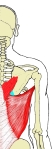 Boundaries
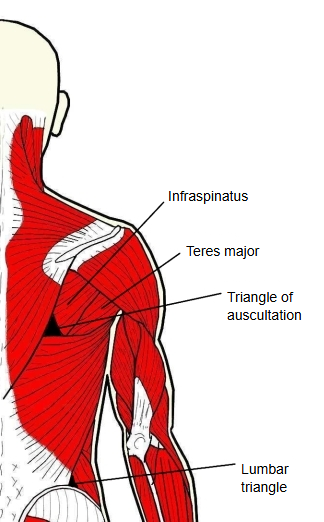
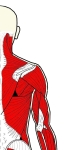 Muscles of the back
Reference websites
[Wikipedia]
· Triangle of auscultation, Wikipedia.
[Websites with illustrations]
· Triangle of auscultation: location and function (Kenhub)
Boundaries
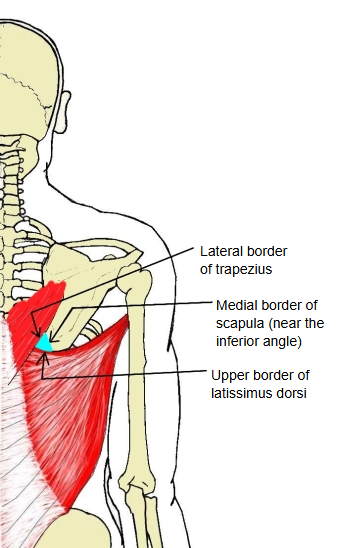
Its boundaries are:
Medially (and above): the lower, lateral border of trapezius.
Below: the upper border of latissimus dorsi.
Laterally: the medial border of the scapula, near the inferior angle.
Its floor is formed by the rhomboid major; deep to it, and in the lower part of the triangle, lie the 6th and 7th ribs and the 6th intercostal space with the internal and external intercostal muscles. The triangle becomes larger when the arms are folded across the chest and the trunk is bent forward, because the scapulae move laterally; breath sounds of the lower lobe of the lung are then heard clearly, and surgeons can use it to enter the chest with little cutting of muscle.
Related terms
- Lumbar triangle
- Inferior angle of scapula
- Borders of the scapula
- Intercostal space
- Erector spinae
- Posterior triangle of neck
References and sources
- Further reading: Triangle of auscultation, Wikipedia.
- Federative International Programme for Anatomical Terminology (FIPAT). Terminologia Anatomica, 2nd ed. (TA2), 2019.