Erector spinae (Latin: musculus erector spinae)
Also called the erector muscles of spine or the sacrospinalis
It lies in the groove on each side of the spinous processes, covered in the lumbar and thoracic regions by the thoracolumbar fascia. In the neck it lies beside the nuchal ligament, the midline sheet that separates the muscles of the two sides, under the splenius muscles. It arises by a thick common tendon from the sacrum, the iliac crest and the lumbar spinous processes, and in the upper lumbar region it splits into three columns.
- Iliocostalis : the outermost column, to the ribs and the lower cervical transverse processes; parts: iliocostalis lumborum, thoracis and cervicis
- Longissimus : the middle and longest column, up to the transverse processes and the mastoid process; parts: longissimus thoracis, cervicis and capitis
- Spinalis : the innermost column, between spinous processes; parts: spinalis thoracis, cervicis and capitis
Acting on both sides it extends (straightens) the vertebral column and holds the trunk upright; acting on one side it bends the trunk to that side. It is supplied by the dorsal rami of the spinal nerves.
The diagram below shows the classification of the muscles of the back.
- Superficial back muscles (5) : = spinohumeral muscles
- 1st layer (2)
- 2nd layer (3)
- Deep back muscles (16)
- 1st layer (2) : = spinocostal muscles
- 2nd layer (14)
- Muscles of the vertebral column (10) : = intrinsic back muscles
- Splenius muscles (2)
- Erector spinae (3) : iliocostalis, longissimus, spinalis
- Transversospinalis muscles (3)
- Others (2)
- Suboccipital muscles (4)
- Muscles of the vertebral column (10) : = intrinsic back muscles
The superficial (extrinsic) back muscles act on the upper limb; the deep (intrinsic) muscles belong to the back itself. Among the intrinsic muscles, the erector spinae lies between the splenius muscles (more superficial, in the neck) and the transversospinalis group (deeper). The suboccipital muscles form a separate small group at the top of the neck.
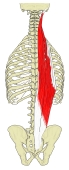 Iliocostalis and longissimus
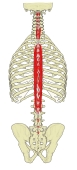 Spinalis
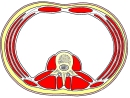 Abdomen (transverse section)
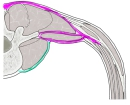 Thoracolumbar fascia at L3
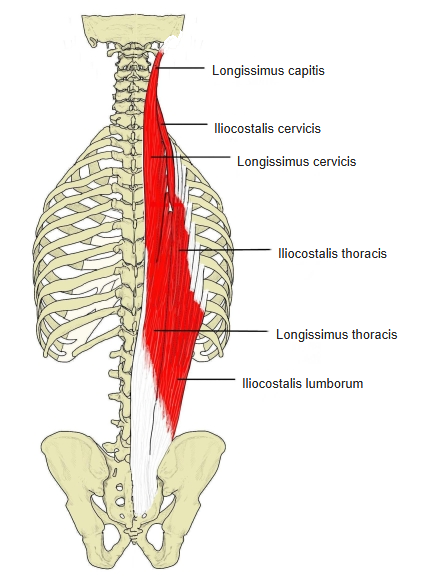
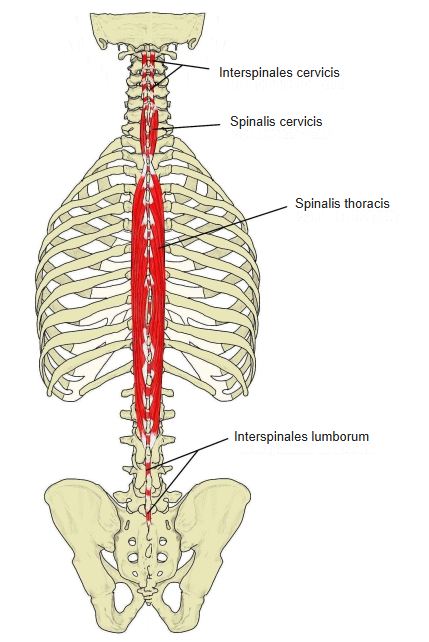
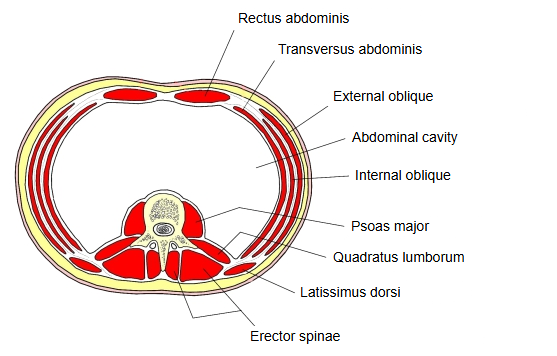
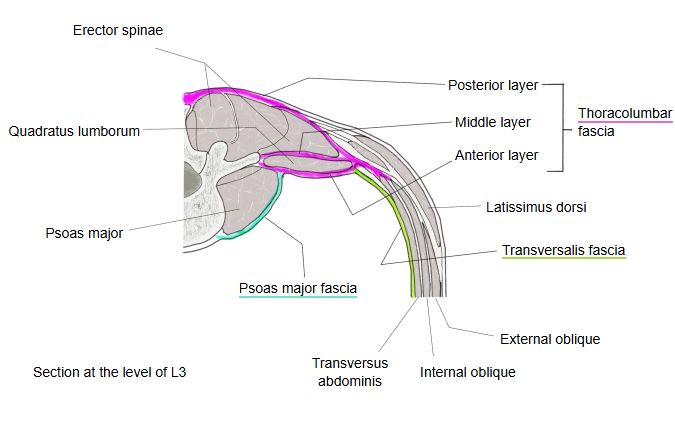
"Erector spinae" is a functional name: the three muscles work together to extend the vertebral column and keep the body upright. By structure and development, however, the iliocostalis and longissimus belong to a lateral group, while the spinalis belongs to a separate medial group.
Reference websites
[Wikipedia]
· Erector spinae muscles, Wikipedia.
[Websites with illustrations]
· Erector spinae and its parts, posterior view (corewalking.com)

Cross-sections
· Cross-section through the L2 lumbar region, with the erector spinae labelled (Medical Stock Images)

Related terms
- Iliocostalis
- Vertebral canal
- Vertebral cavity
- Groove for spinal nerve
- Medullary cone
- Vertebral region
- Intrinsic back muscles
- Muscles of the back
- Spinalis
- Transversospinalis muscles
- Splenius muscles
- Thoracolumbar fascia
- Iliocostalis lumborum
References and sources
- Further reading: Erector spinae muscles, Wikipedia.
- Federative International Programme for Anatomical Terminology (FIPAT). Terminologia Anatomica, 2nd ed. (TA2), 2019.