Epimysium
Also called the external perimysium (older name)
The epimysium is the connective-tissue sheath that binds the muscle fascicles together into a whole muscle; an older name is external perimysium.
It is dense irregular connective tissue
These are the three sheaths that wrap a muscle.
Sheaths
of a
muscle
of a
muscle
- Endomysium : loose connective tissue around each muscle fiber (muscle cell).
- Perimysium : loose connective tissue around each fascicle, a bundle of a few to several dozen muscle fibers.
- Epimysium : dense connective tissue around the whole muscle, made of many fascicles.
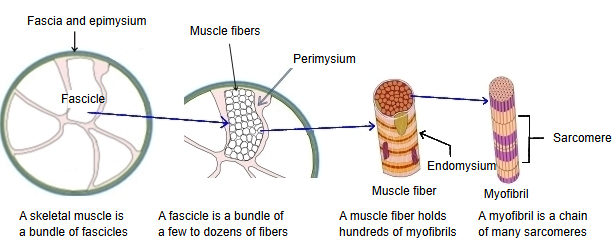
 Connective-tissue sheaths of a muscle
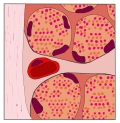 Muscle fibers and their sheaths
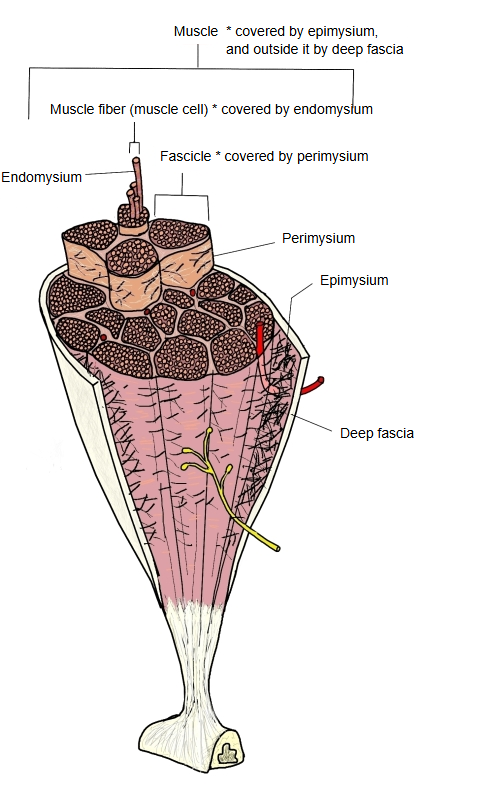
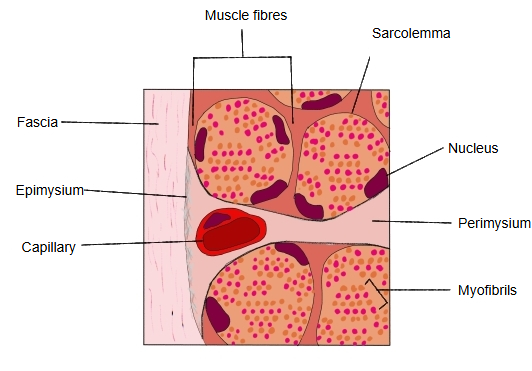
The diagram below shows where the epimysium stands among the fasciae. Note that Terminologia Anatomica does not recommend dividing the fasciae into superficial and deep fascia in this way (see the box below).
Fascia
- Superficial fascia : the subcutaneous tissue, containing blood vessels, nerves, lymph nodes and fat.
- Deep fascia : the sheet-like connective tissue deep to the subcutaneous tissue that covers the deeper structures; broadly of two kinds: (1) the sheaths that wrap muscles directly (muscular fascia: endomysium, perimysium, epimysium) and (2) the sheaths that wrap organs and vessels (visceral fascia).
The word fascia is used for the sheaths of organs as well as for the sheaths of muscles, which easily causes confusion, so Terminologia Anatomica (TA) recommends these terms:
Superficial fascia ⇒ subcutaneous tissueDeep fascia ⇒ muscular fascia and visceral fascia
Standard anatomy textbooks describe the structure of a muscle as follows.
A muscle is made of many muscle fibers (muscle cells) bound together by connective tissue. Each fiber is wrapped in endomysium, each fascicle in perimysium, and the surface of the whole muscle in the strong, dense epimysium. At both ends the muscle usually passes into a tendon that attaches to bone or to a ligament.
Reference websites
[Wikipedia]
· Epimysium, Wikipedia.
Related terms
References and sources
- Further reading: Epimysium, Wikipedia.
- Federative International Programme for Anatomical Terminology (FIPAT). Terminologia Anatomica, 2nd ed. (TA2), 2019.