Deep fascia (Latin: fascia profunda)
Also called the investing fascia
Overview
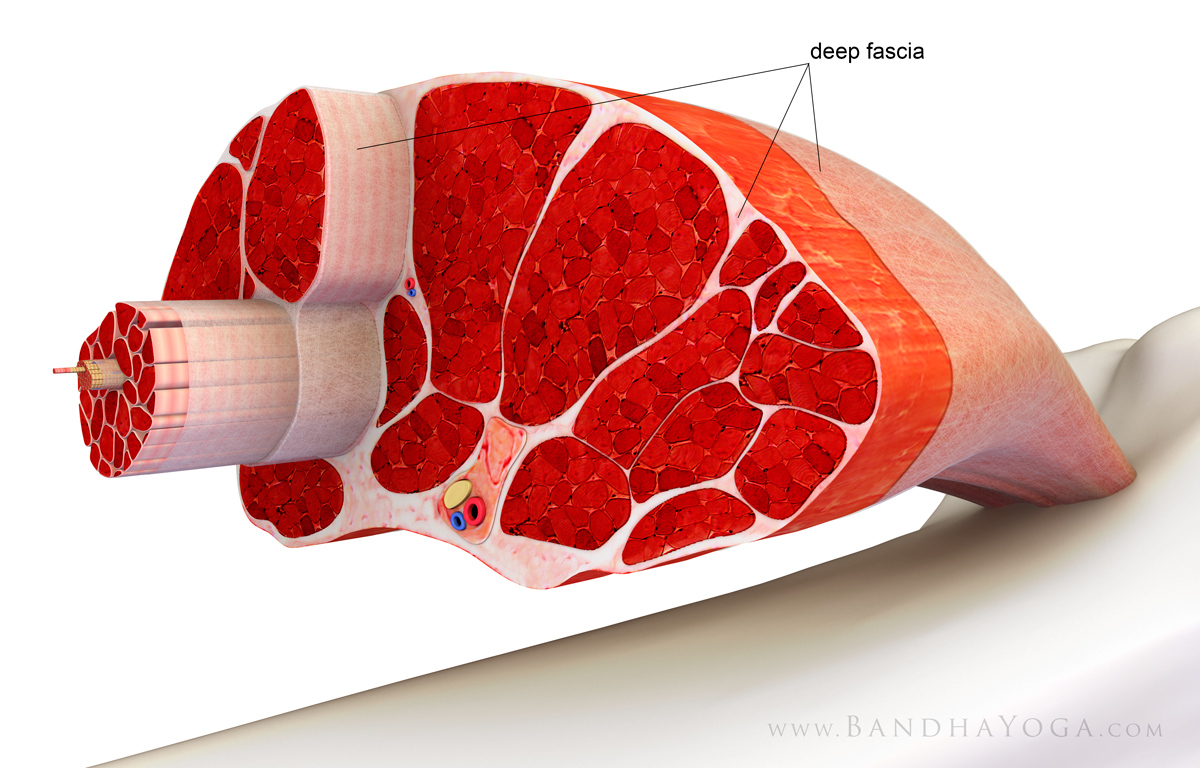
The deep fascia is the sheet of connective tissue that wraps and encloses each skeletal muscle, as part of the fascia.
Smooth muscle is not enclosed by deep fascia
· Smooth muscle is part of the wall of organs and vessels and is not a separate organ like a skeletal muscle, so it is not wrapped by deep fascia.
· Originally the word fascia meant the sheath covering a muscle; today any sheet-like layer of connective tissue may be called fascia.
Meaning of fascia — in the past: a sheath that wraps a muscle; today: a sheet-like structure of connective tissue.
| Fascia | Narrow sense | Superficial fascia: loose connective tissue just under the skin, often containing fat (= subcutaneous tissue) |
| Deep fascia: dense connective tissue that directly encloses the muscles; from outside inward it continues as the epimysium, the perimysium and the endomysium | ||
| Wide sense | Sheets that cover organs and vessels, for example the carotid sheath, the peribronchial fascia and the renal fascia |
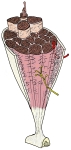 Fascia
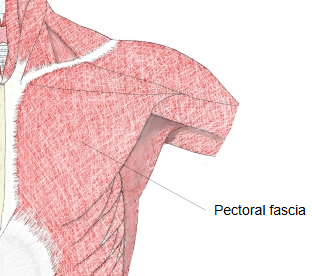
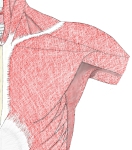 Pectoral fascia
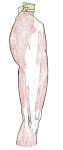 Fascia of the thigh
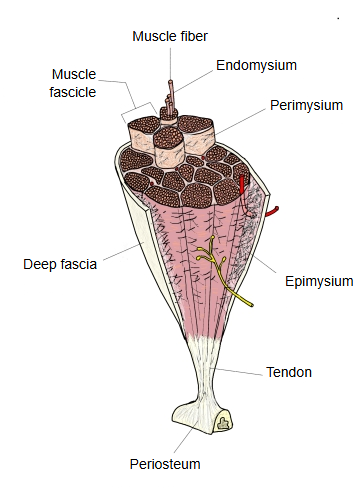
Composition
The deep fascia binds muscle bundles together and must be strong and tough, so its main component is collagen fibres.
| Component | Content | Role |
|---|---|---|
| Collagen fibres (the main part) | Dense bundles of collagen | Strength and resistance to pulling |
| Elastic fibres (a small part) | Elastin | Some stretch and recoil |
| Ground substance | Water, proteoglycans, hyaluronan | Keeps the tissue moist; lets layers glide |
| Cells (few) | Mainly fibroblasts | Make and repair the fibres and the ground substance |
Reference websites
[Wikipedia]
· Deep fascia, Wikipedia.
· Fascia, Wikipedia.
[Websites with illustrations]
· Fascia layers (illustration) (Pinterest)

· Fascia of a muscle (Bandha Yoga)
Related terms
- Fascia
- Subcutaneous fascia
- Subcutaneous tissue
- Endomysium
- Pectoral fascia
- Fascia lata
- Dense connective tissue
References and sources
- Further reading: Deep fascia, Wikipedia.
- Further reading: Fascia, Wikipedia.
- Federative International Programme for Anatomical Terminology (FIPAT). Terminologia Anatomica, 2nd ed. (TA2), 2019.