Cerebral surface of parietal bone (Latin: facies interna ossis parietalis)
Also called the internal surface of the parietal bone.
One of the two surfaces of the parietal bone: the surface that faces the cerebrum. It is also called the internal surface. It is concave and shows digital impressions, low ridges between them (cerebral juga) and arterial grooves for the branches of the middle meningeal artery. Along the sagittal border lie part of the groove for the superior sagittal sinus and granular foveolae, and at the mastoid angle a short part of the groove for the sigmoid sinus.
The parietal bone has two surfaces: the parietal surface (= external surface) and the cerebral surface (= internal surface).
Cerebral surface: concave, with digital impressions, cerebral juga and arterial grooves
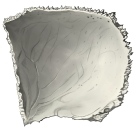 Parietal bone (internal surface)
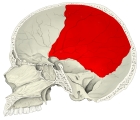 Cerebral surface of the parietal bone
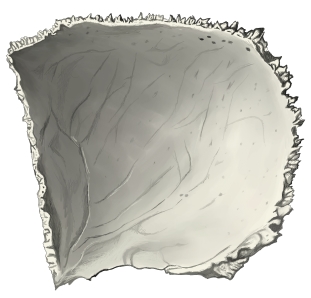
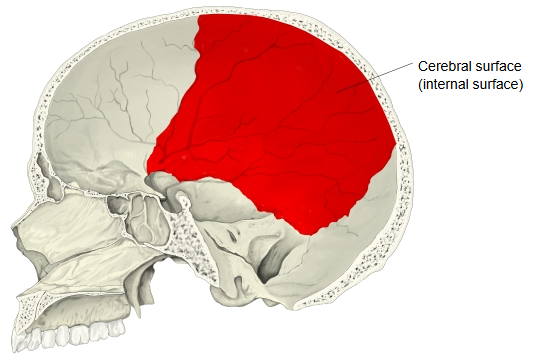
⇒ The two surfaces of the parietal bone
Related terms
- External surface of parietal bone
- Parietal bone
- Digital impressions
- Arterial grooves
- Parietal foramen
- Groove for superior sagittal sinus
- Granular foveolae
- Cerebral surface of squamous part of temporal bone
- Cerebral surface of frontal bone
References and sources
- Further reading: Parietal bone, Wikipedia.
- Federative International Programme for Anatomical Terminology (FIPAT). Terminologia Anatomica, 2nd ed. (TA2), 2019.