Groove for sigmoid sinus (Latin: sulcus sinus sigmoidei)
Also called the sulcus for the sigmoid sinus
sigmoid sinus
- Upper part : runs on the inner surface of the mastoid part (a part of the petrous part) of the temporal bone.
- Lower part : runs on the occipital bone, from lateral to medial, on each side of the foramen magnum.
| Bone | Occipital bone | Temporal bone (inner surface of the mastoid part) | Occipital bone | |
| Vein | Internal jugular vein ← jugular foramen | Sigmoid sinus | Sigmoid sinus (the mastoid foramen opens here) | Transverse sinus |
| Groove | Groove for sigmoid sinus | Groove for transverse sinus | ||
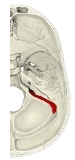 Internal cranial base
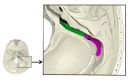 Internal cranial base (enlarged)
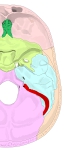 Internal cranial base (bones coloured)
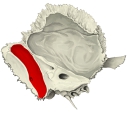 Temporal bone (medial surface)
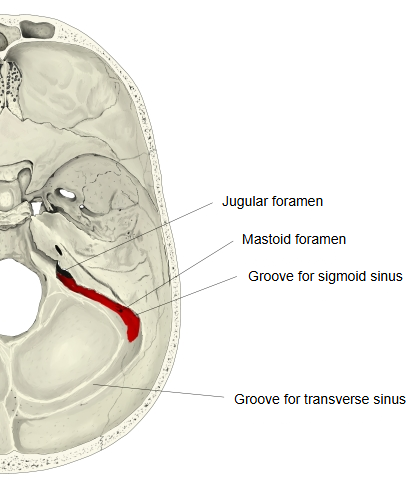
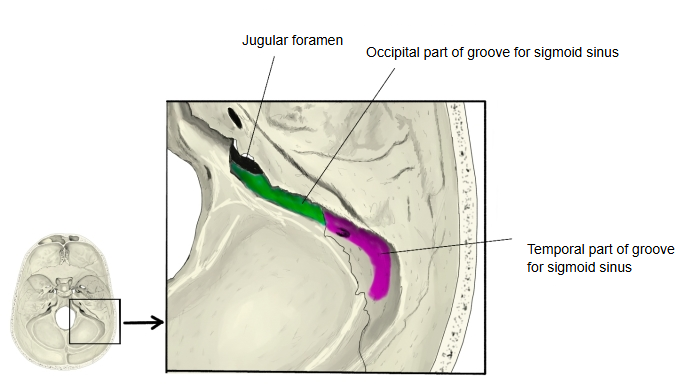
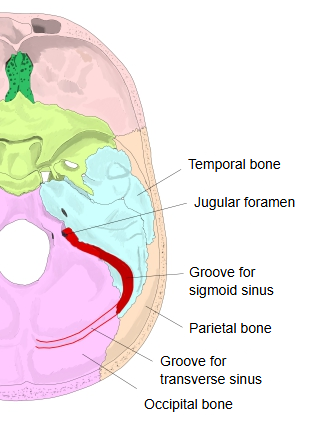
The groove is S-shaped. It continues the groove for the transverse sinus at the inner surface of the mastoid part, where it also touches the mastoid angle of the parietal bone (sources differ on how far it extends onto the parietal bone), and curves down and forwards on the occipital bone around the jugular process to the jugular foramen, where the sinus becomes the internal jugular vein. The mastoid foramen, for an emissary vein, usually opens into the part on the temporal bone, and the condylar canal may open into its lower end. Only a thin plate of bone separates the groove from the mastoid air cells, so infection of the middle ear can spread to the sinus.
Reference websites
[Wikipedia]
· Groove for sigmoid sinus, Wikipedia.
· Sigmoid sinus, Wikipedia.
[Websites with illustrations]
· Base of the skull, inner surface (Gray's Anatomy) (Wikimedia Commons)

· Left temporal bone, inner surface (Gray's Anatomy) (Wikimedia Commons)

· Temporal bone: anatomy, parts, sutures and foramina (Kenhub)
Related terms
- Groove for transverse sinus
- Jugular foramen
- Posterior cranial fossa
- Jugular process
- Petrous part
- Mastoid process
- Sigmoid sinus
References and sources
- Further reading: Sigmoid sinus, Wikipedia.
- Federative International Programme for Anatomical Terminology (FIPAT). Terminologia Anatomica, 2nd ed. (TA2), 2019.