Soleal line (Latin: linea musculi solei)
Also called the popliteal line
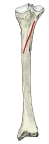
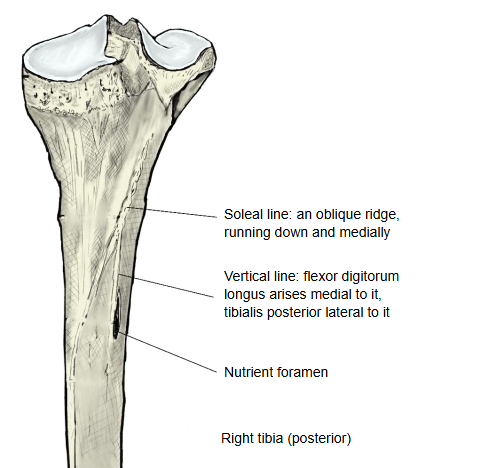
An oblique ridge on the upper part of the posterior surface of the tibia, running down and medially from below the lateral condyle. It is the origin of soleus. It runs from just below and behind the fibular articular facet to the medial border, at about the junction of the upper and middle thirds of the shaft.
The triangular area above the line receives popliteus; the line marks the lower edge of this insertion, and the fascia over popliteus is attached to it. Soleus arises from the line itself (and from the middle third of the medial border). Below the line, a faint vertical ridge runs down medial to the large nutrient foramen: flexor digitorum longus arises from the wider area medial to it and tibialis posterior from the narrower area lateral to it. This vertical ridge is where the fascia covering tibialis posterior is attached.
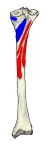 Muscle attachments (posterior)
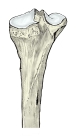 Upper end of right tibia (posterior)
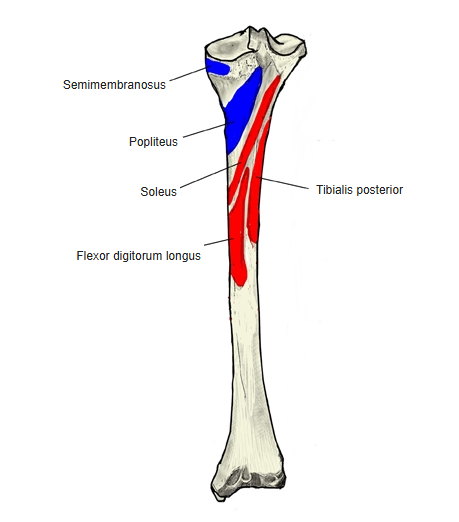
Attached structures
| Muscle | 1 | Soleus (origin) | its tibial origin, along the line and the middle third of the medial border |
Reference websites
[Wikipedia]
· Soleal line, Wikipedia.
· Soleus muscle, Wikipedia.
· Tibia, Wikipedia.
[Websites with illustrations]
· Bones of the right leg, posterior surface (Gray's Anatomy) (Wikimedia Commons)

· The tibia (TeachMeAnatomy)
· Tibia: anatomy (Kenhub)
Where it is found
Related terms
- Posterior surface of tibia
- Medial border of tibia
- Lateral condyle of tibia
- Fibular articular facet
- Interosseous border of tibia
- Shaft of tibia
References and sources
- Further reading: Soleus muscle, Wikipedia.
- Further reading: Tibia, Wikipedia.
- Federative International Programme for Anatomical Terminology (FIPAT). Terminologia Anatomica, 2nd ed. (TA2), 2019.