Head of rib (Latin: caput costae)
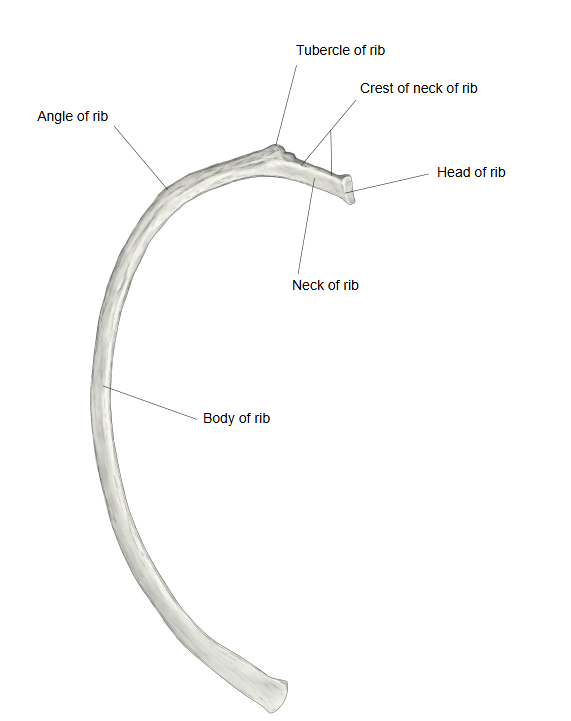
- Head of rib : the enlarged back end, joined to the bodies of the thoracic vertebrae.
- Neck of rib : the narrowed part between the head and the tubercle.
- Tubercle of rib : the thickened part on the back of the rib where the neck meets the body.
- Body of rib : the long, curved part of the bone from the front end to the tubercle.
Ribs with one facet
Ribs: 1st, 11th and 12th (often the 10th too). The single facet meets the vertebra of the same number only.
Ribs with two facets
Ribs: 2nd to 9th (and the 10th when it has two facets). The upper facet meets the vertebra above, the lower facet the vertebra of the same number.
A horizontal ridge, the crest of the head of the rib, divides the facet into an upper and a lower part.
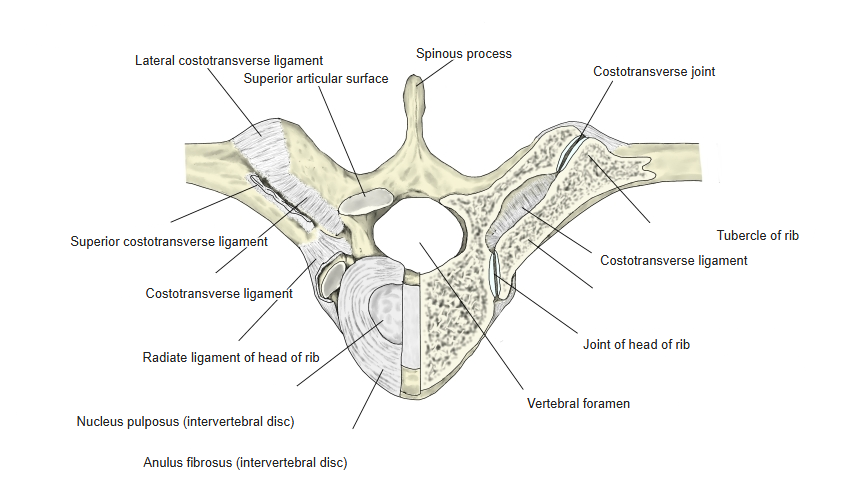
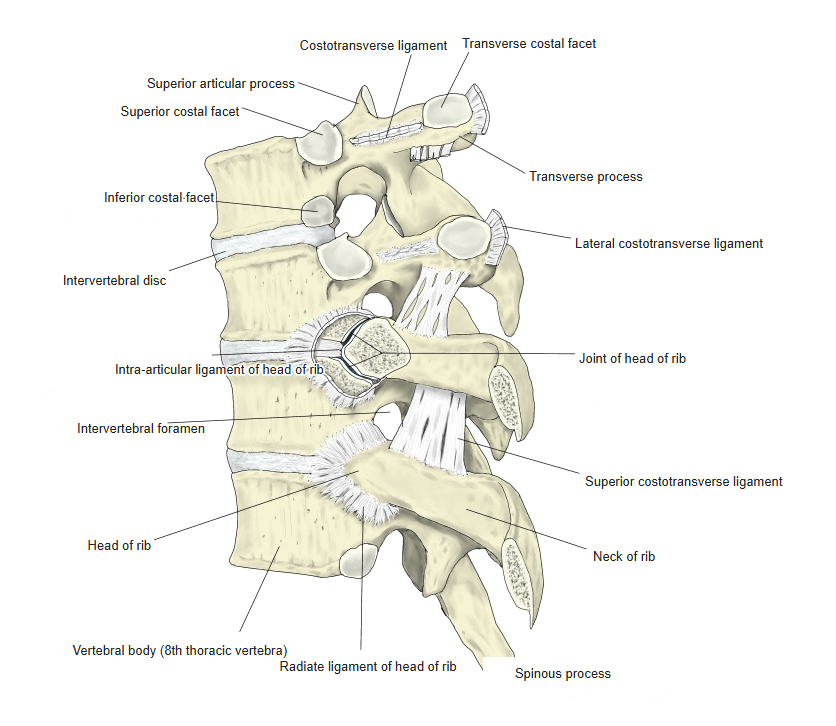
The intra-articular ligament of head of rib runs from the crest to the intervertebral disc, so the joint cavity of the joint of the head of the rib is divided in two. In front, the joint capsule is reinforced by the radiate ligament of head of rib.
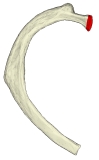 Right 2nd rib (superior view)
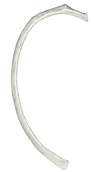 Right 5th rib (superior view)
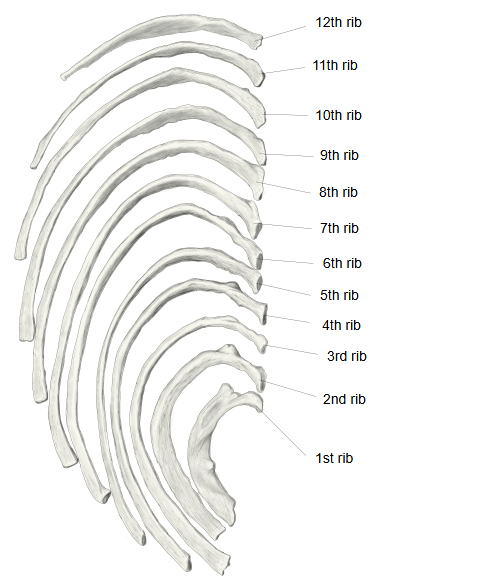
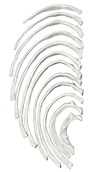 Right ribs 1–12 (superior view)
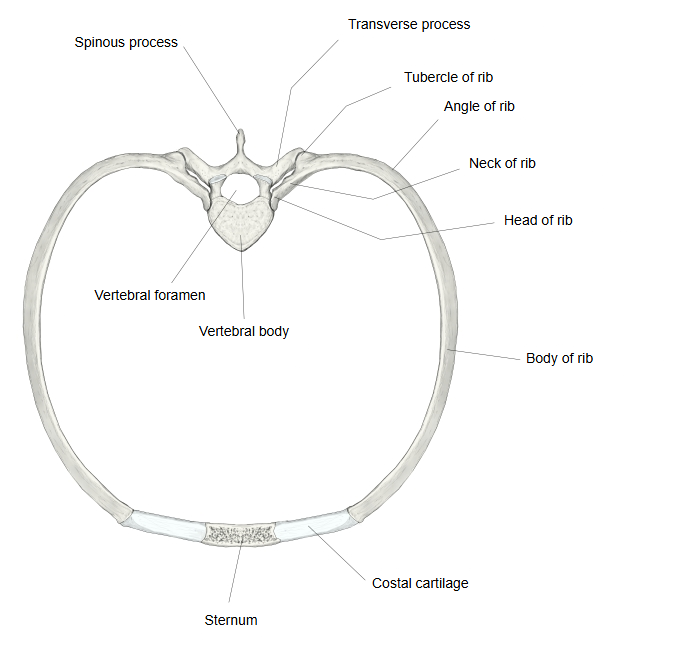 A pair of ribs with their vertebra (superior view)
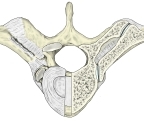 Costovertebral joints (superior view)
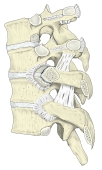 Costovertebral joints (lateral view)
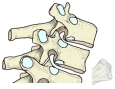 Joints of the heads of ribs 1 and 2
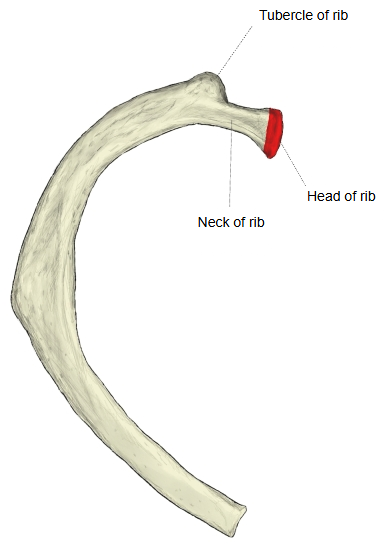
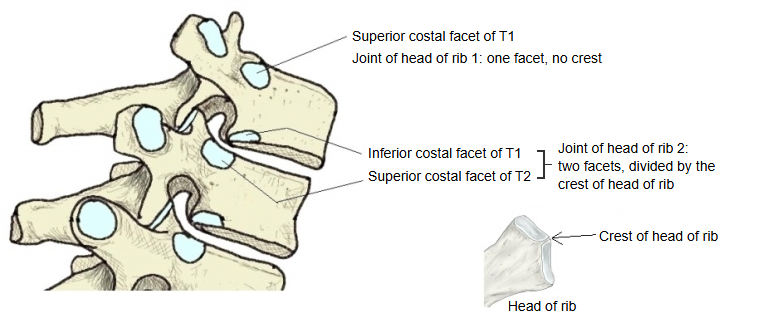
In more detail:
The head of the rib is the swollen back end of the costal bone. It carries the articular facet of the head of the rib, which meets the costal facets on the bodies of the thoracic vertebrae; in ribs 2–9 (and the 10th when it has two facets) this facet is wedge-shaped. A little under 3 cm from the head, an oval elevation, the tubercle of the rib, projects backwards. It carries the articular facet of the tubercle, which meets the transverse costal facet on the transverse process of the thoracic vertebra.
Medical dictionaries define it as follows:
The rounded inner (medial) end of a rib. Except for the ribs with a single facet (1, 10, 11 and 12), it articulates by two facets with the bodies of two neighbouring vertebrae.
Reference websites
[Wikipedia]
· Rib, Wikipedia.
· Costovertebral joints, Wikipedia.
[Websites with illustrations]
· The ribs and rib cage (TeachMeAnatomy)
· A central rib of the left side, inferior aspect (Gray's Anatomy) (Wikimedia Commons)

· Video: Ribs - Typical & Atypical, True & False ribs
Where it is found
Related terms
References and sources
- Further reading: Rib, Wikipedia.
- Further reading: Costovertebral joints, Wikipedia.
- Federative International Programme for Anatomical Terminology (FIPAT). Terminologia Anatomica, 2nd ed. (TA2), 2019.