Body of rib (Latin: corpus costae)
Also called Shaft of rib
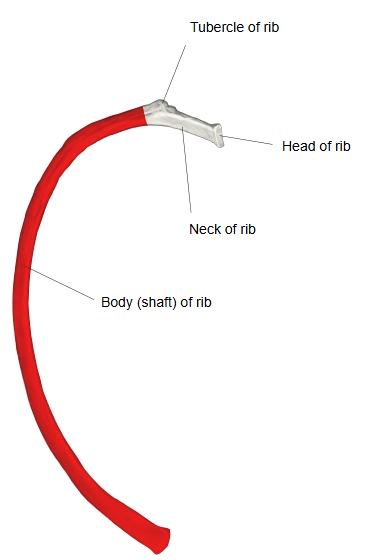
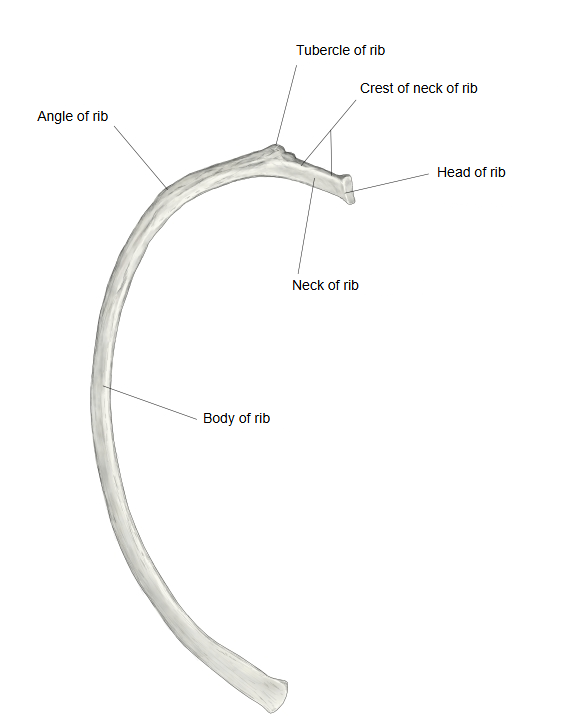
From the neck it runs laterally and backwards, turns forwards at the angle of rib, and then curves around the side of the chest towards the front, where it joins its costal cartilage. It is thin and flat, with an outer and an inner surface; the upper border is rounded and the lower border is sharp (the crest of body of rib).
On the inner surface, along the lower border, runs the costal groove, which carries the intercostal vessels and nerve. Muscles described as attaching to the ribs, such as the external and internal intercostal muscles, serratus anterior and external oblique, attach mainly to the body.
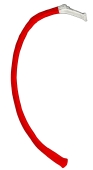 Right 5th rib (superior view)
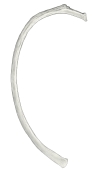 Right 5th rib (superior view)
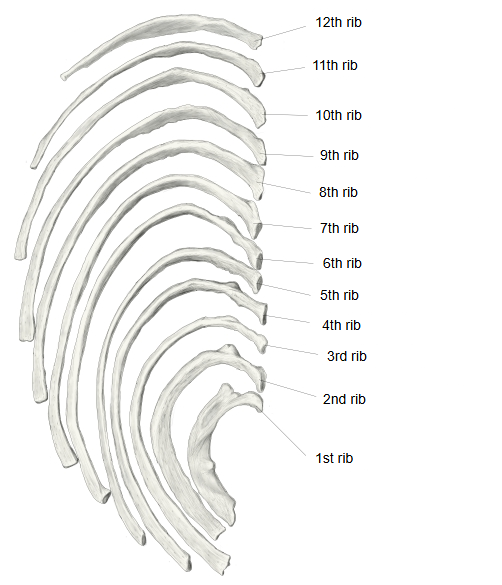
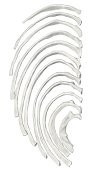 Right ribs 1–12 (superior view)
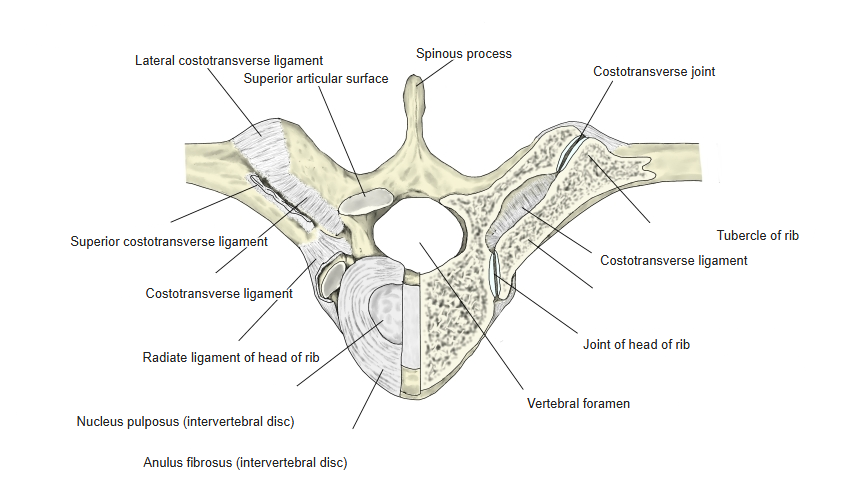
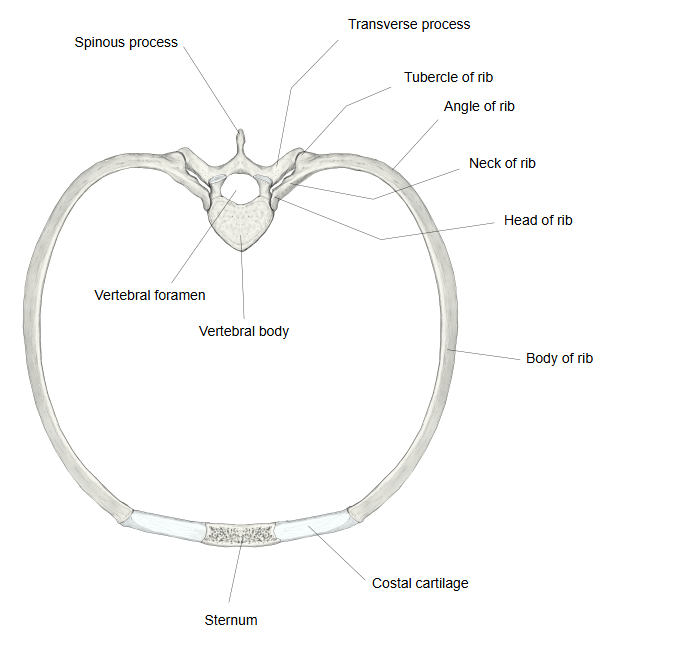 A pair of ribs with their vertebra (superior view)
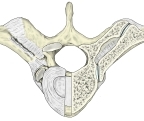 Costovertebral joints (superior view)
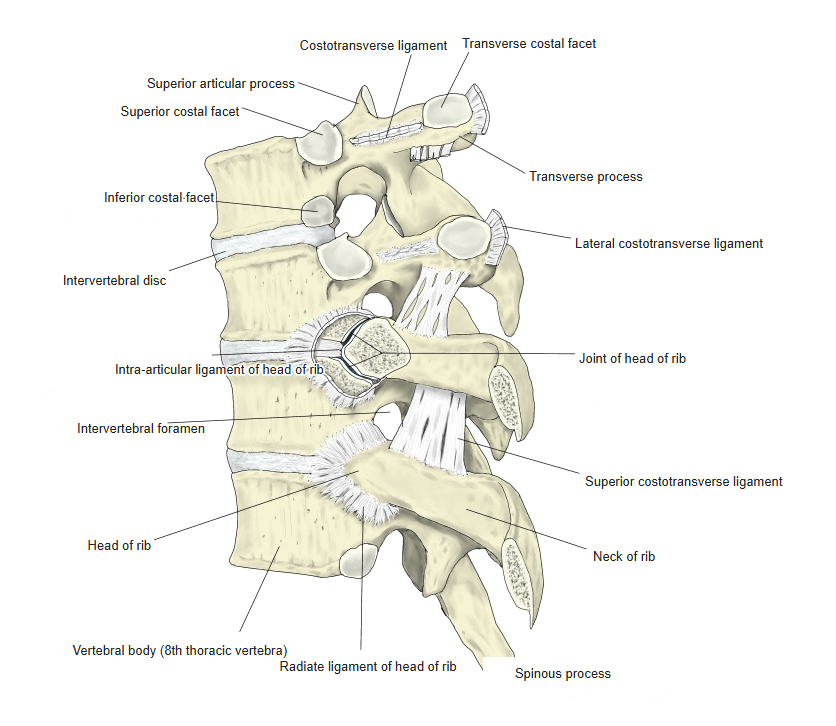
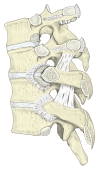 Costovertebral joints (lateral view)
Reference websites
[Wikipedia]
· Rib, Wikipedia.
[Websites with illustrations]
· A central rib of the left side, inferior aspect (Gray's Anatomy, fig. 122) (Wikimedia Commons)

· Ribs (Kenhub)
Video
Related terms
- Costal bone
- Neck of rib
- Angle of rib
- Crest of neck of rib
- Crest of head of rib
- Crest of body of rib
- Articular facet of head of rib
- Head of rib
- Tubercle of rib
- Costal groove
- Costal cartilage
- Ribs
- Thoracic vertebrae
References and sources
- Further reading: Rib, Wikipedia.
- Federative International Programme for Anatomical Terminology (FIPAT). Terminologia Anatomica, 2nd ed. (TA2), 2019.