Latin: vomer
Overview
- A thin, roughly quadrilateral, unpaired bone in the midline that forms the lower and back part of the nasal septum; the upper part of the septum is formed by the perpendicular plate of the ethmoid.
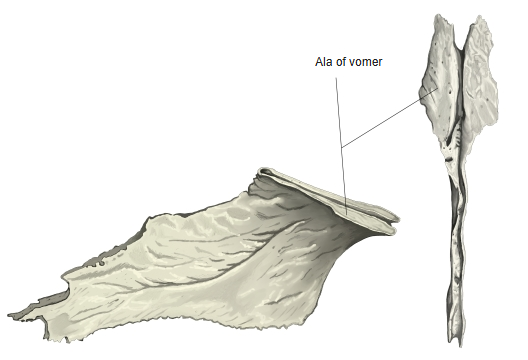
- Its name comes from the Latin for a ploughshare, after its shape. It lies in the median plane, but its front part is often bent to one side.
- It has two surfaces and four borders. Each surface carries the oblique nasopalatine groove for the nasopalatine nerve and vessels.
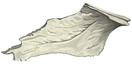
Vomer (lateral and anterior)
- Bones of the skull
- Neurocranium (cranial bones)
- Frontal bone
- Parietal bone (2)
- Occipital bone
- Temporal bone (2)
- Sphenoid bone
- Ethmoid bone
- Viscerocranium (facial bones)
- Nasal bone (2)
- Vomer
- Lacrimal bone (2)
- Inferior nasal concha (2)
- Maxilla (2)
- Zygomatic bone (2)
- Palatine bone (2)
- Mandible
- Hyoid bone
- Neurocranium (cranial bones)
Illustrations
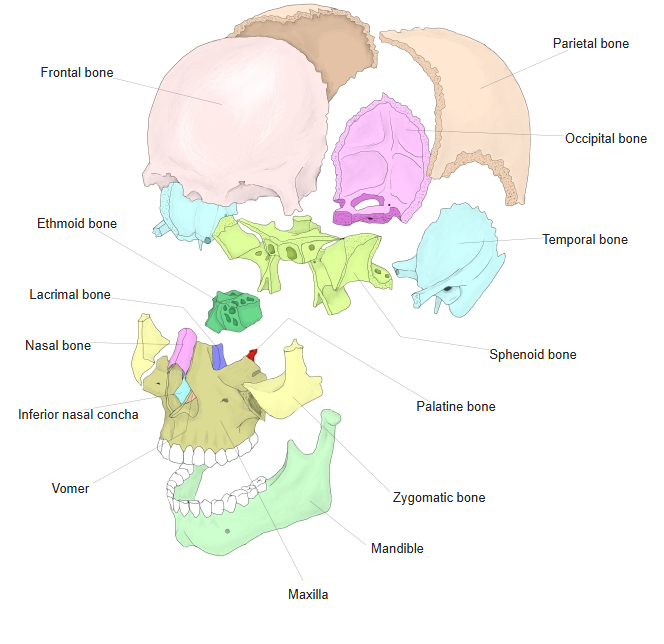
Bones of the skull (separated)
Articulations
| # | Bone | Joint |
|---|---|---|
| 1 | Sphenoid bone | Body and rostrum (with the alae) |
| 2 | Ethmoid bone | Perpendicular plate |
| 3 | Maxillae | Nasal crest |
| 4 | Palatine bones | |
| 5 | Septal cartilage of the nose | Anterior border |
Muscle attachments
- Origin of: none
- Insertion of: none
No muscles attach to the vomer.
Borders
- Superior border – the thickest; it splits into the two alae of the vomer, which embrace the rostrum of the sphenoid.
- Inferior border – joins the nasal crest of the maxillae and palatine bones.
- Anterior border – joins the perpendicular plate of the ethmoid above and the septal cartilage below.
- Posterior border – free; it separates the two choanae.
References and sources
- Further reading: Vomer, Wikipedia.