Choana (Latin: choana)
Also called the posterior nasal aperture or the posterior naris or the plural choanae
· Also called the posterior naris, internal naris or posterior nasal aperture.
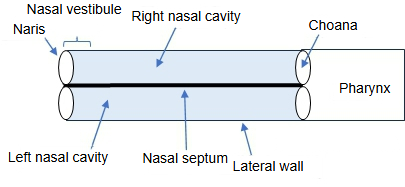
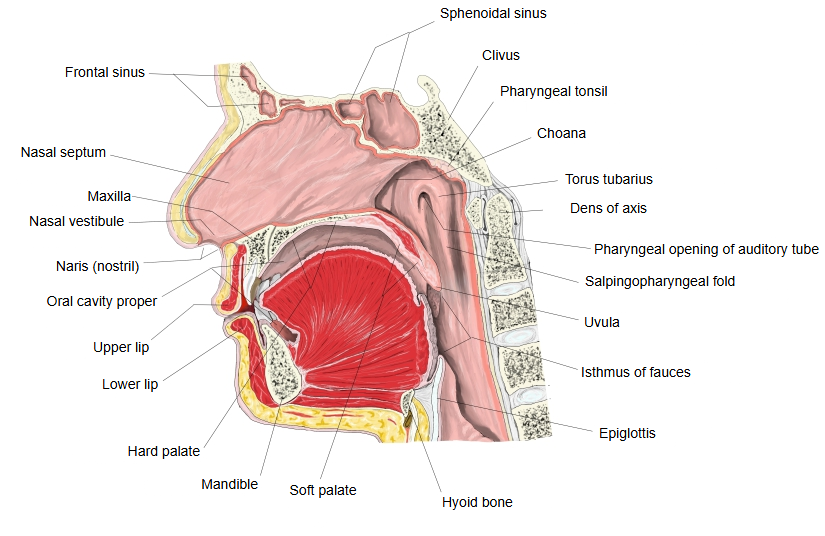
· The choana is the boundary between the nasal cavity and the pharynx: each half of the nasal cavity runs from the external naris in front to the choana behind, where it opens into the nasopharynx.
· The two choanae lie side by side, separated by the posterior border of the vomer (nasal septum). Their bony margins are: above, the body of the sphenoid bone and the ala of the vomer; below, the horizontal plate of the palatine bone; laterally, the medial plate of the pterygoid process. In life each is lined by mucous membrane and is roughly 2.5 cm high and 1.3 cm wide in the adult.
· Choanal atresia is a congenital blockage of the choana; when both sides are closed, a newborn cannot breathe through the nose.
Where it is found
Related terms
References and sources
- Further reading: Choana, Wikipedia.
- Further reading: Choanal atresia, Wikipedia.
- Federative International Programme for Anatomical Terminology (FIPAT). Terminologia Anatomica, 2nd ed. (TA2), 2019.