Ala of vomer (Latin: ala vomeris)
Also called Wing of vomer (plural: alae)
The ala of the vomer is one of the two wing-like lips that spread out to each side from the back part of the upper border of the vomer.
Vomer: one of the bones of the facial skeleton; it forms the lower back part of the nasal septum
The two alae hold the sphenoidal rostrum of the underside of the body of the sphenoid bone between them, and with the vaginal process of the pterygoid process they may enclose the vomerovaginal canal.
Pterygoid process: projects downwards from the underside of the sphenoid where the body and the greater wing meet; the vaginal process is a thin plate at the root of its medial plate
The edge of each ala meets the vaginal process of the pterygoid process of the sphenoid and, behind, the sphenoidal process of the palatine bone.
The ethmoid bone (perpendicular plate) meets the front of the upper border of the vomer, not the alae
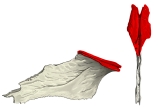 Vomer (lateral and anterior views)
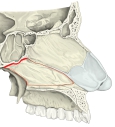 Nasal septum (medial view)
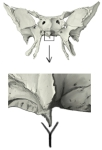 Alae and sphenoidal rostrum
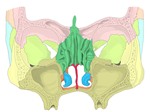 Coronal section (bones colour-coded)
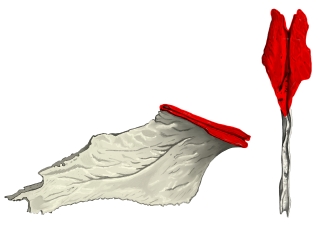
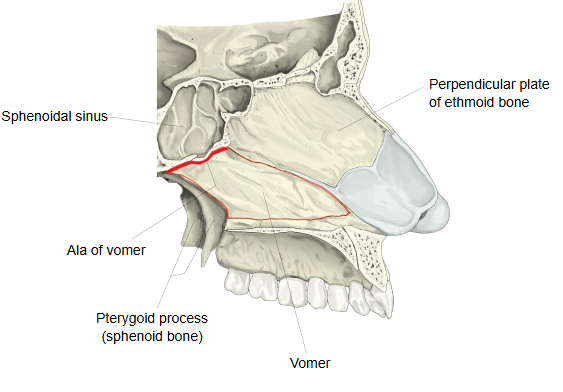
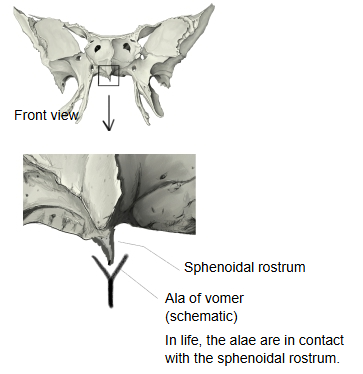
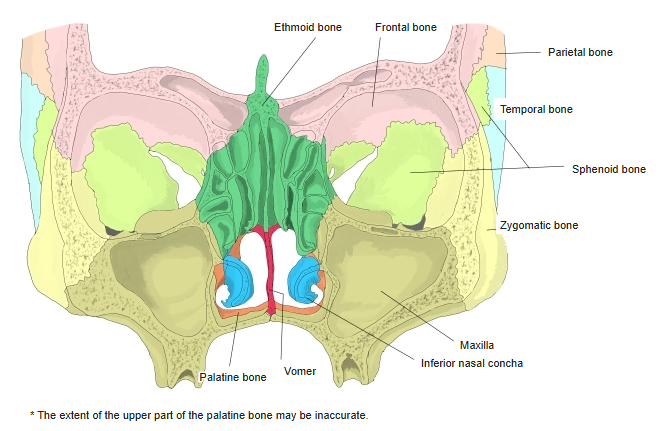
The two alae are separated by a deep groove that receives the sphenoidal rostrum, the ridge on the underside of the body of the sphenoid bone. In this way the upper border of the vomer is fixed to the sphenoid, at the back of the nasal septum, just above the choanae. A small vomerovaginal canal may be left between the ala and the vaginal process. Seen from the front, the vomer with its alae looks like a letter Y.
Reference websites
[Wikipedia]
· Vomer, Wikipedia.
Where it is found
Related terms
References and sources
- Further reading: Vomer, Wikipedia.
- Federative International Programme for Anatomical Terminology (FIPAT). Terminologia Anatomica, 2nd ed. (TA2), 2019.