Latin: Arteriae coronariae
Overview
- The arteries that supply the heart muscle itself; the first branches of the aorta.
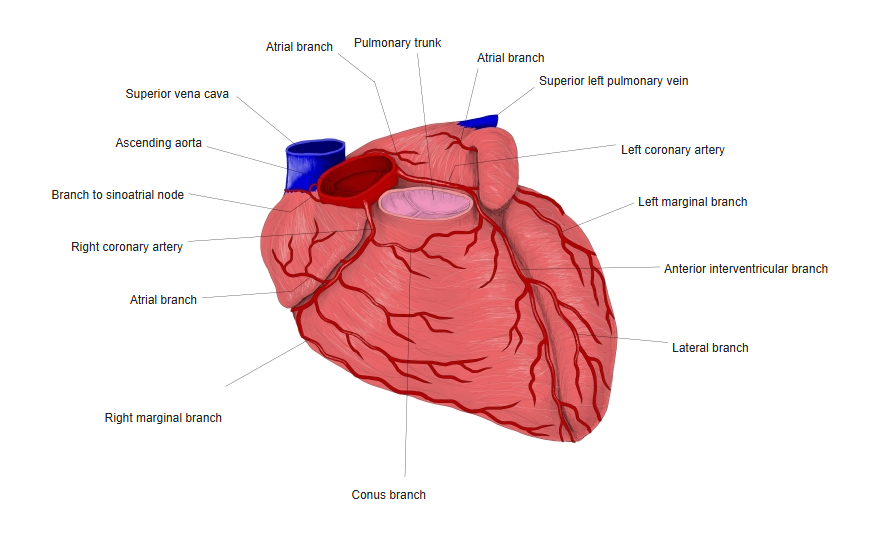
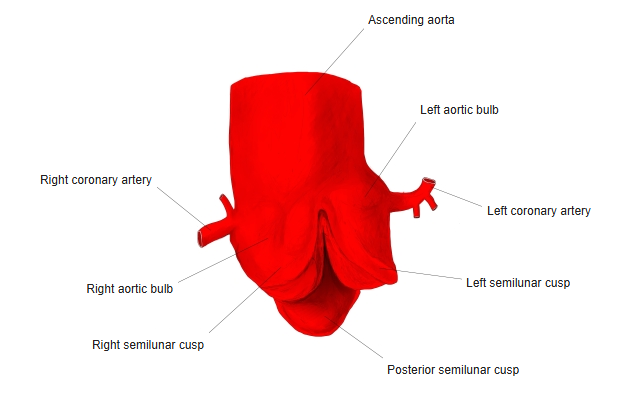
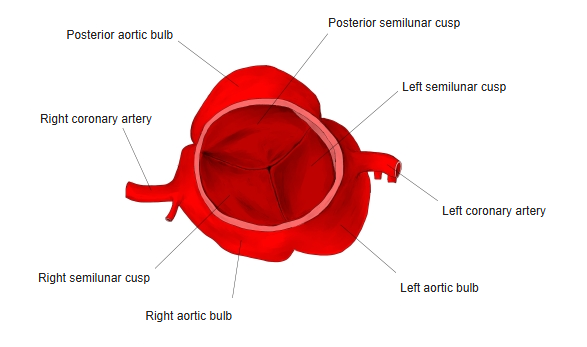
- The right and left coronary arteries arise from the right and left aortic sinuses of the ascending aorta, just above the aortic valve.
- They run in the coronary sulcus and the interventricular grooves on the surface of the heart, under the epicardium.
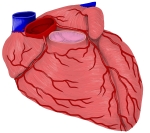
Coronary arteries (front view) 
Aortic root (front view) 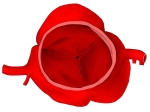
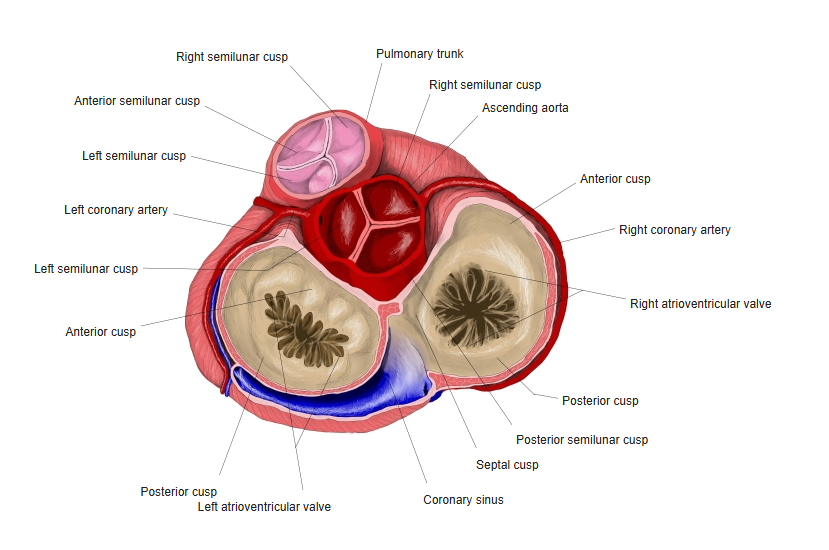
Aortic valve seen from above
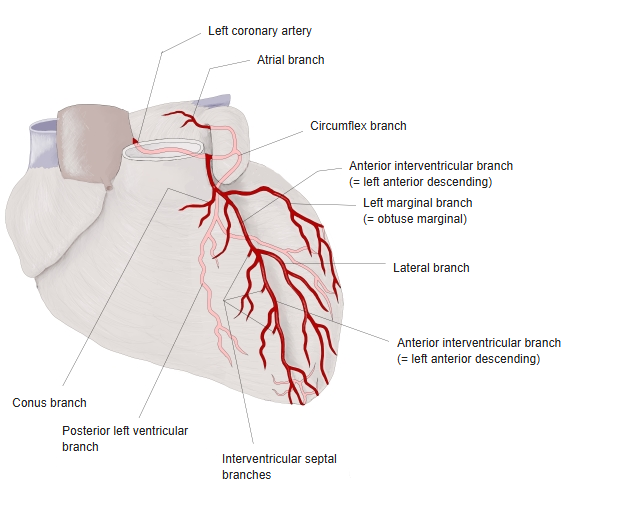
Left coronary artery
- A short trunk that passes between the pulmonary trunk and the left auricle, then divides.
- Anterior interventricular branch (left anterior descending, LAD): runs down the anterior interventricular groove toward the apex; gives diagonal branches and septal branches to the front two-thirds of the interventricular septum.
- Circumflex branch: runs to the left in the coronary sulcus around to the back of the heart; gives the left marginal (obtuse marginal) branch and posterior left ventricular branches.
- Also gives atrial branches and a conus branch.
Left coronary artery and its branches
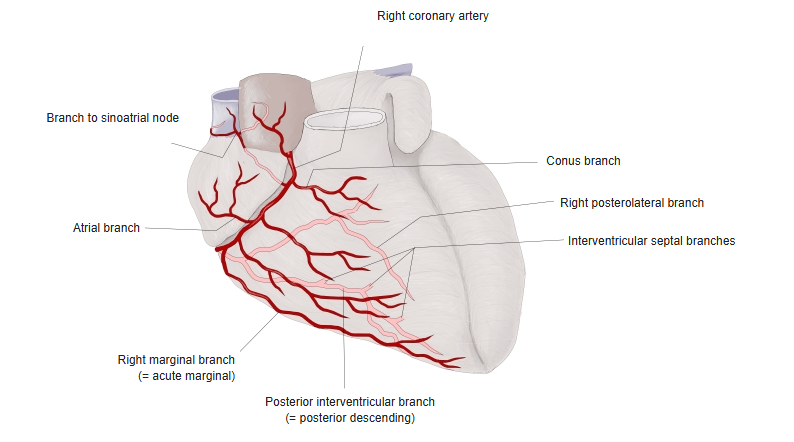
Right coronary artery
- Runs to the right in the coronary sulcus between the right atrium and right ventricle, around to the back of the heart.
- Gives the conus branch, the branch to the sinoatrial node (in about 60% of people) and atrial branches.
- Right marginal (acute marginal) branch along the lower border of the heart.
- Posterior interventricular branch (posterior descending artery) in the posterior interventricular groove, with septal branches; it usually also supplies the atrioventricular node.
Right coronary artery and its branches
Coronary dominance
- The artery that gives the posterior interventricular branch is called dominant.
- In most people (about 70–80%) it is the right coronary artery (right dominance); in others the circumflex branch (left dominance) or both (co-dominance).
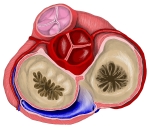
Heart valves seen from above
Clinical notes
- Narrowing of the coronary arteries by atherosclerosis causes angina pectoris; a sudden blockage causes myocardial infarction (heart attack).
- The anterior interventricular branch is the artery most often blocked.
- Blocked arteries can be treated with stents or bypassed with grafts such as the internal thoracic artery.
References and sources
- Further reading: Coronary arteries, Wikipedia.