Latin: Myocardium
Overview
- The muscular middle layer of the heart wall, between the endocardium and the epicardium.
- Made of cardiac muscle: striated like skeletal muscle but involuntary, like smooth muscle.
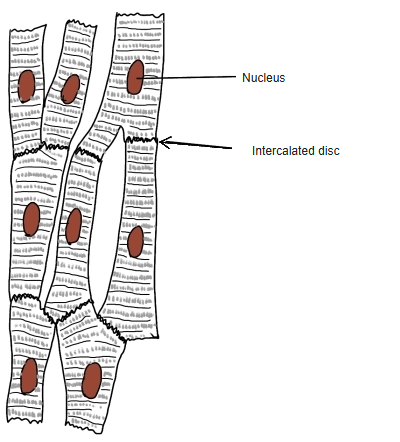
Cardiac muscle cells
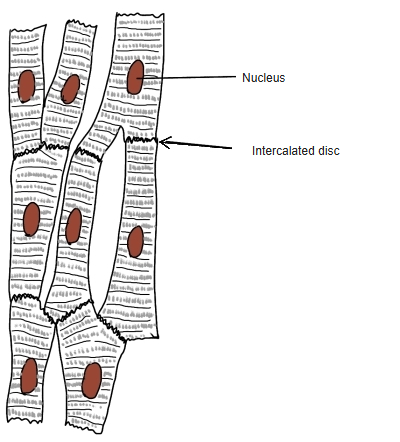
Cardiac muscle cells
- Short branching cells with one (sometimes two) central nucleus.
- Joined end to end by intercalated discs, which contain gap junctions so the impulse passes quickly from cell to cell.
- Rich in mitochondria; depend on a steady oxygen supply from the coronary arteries.
Thickness
- Thin in the atria, thicker in the right ventricle and thickest in the left ventricle.
- Attached to the fibrous cardiac skeleton.
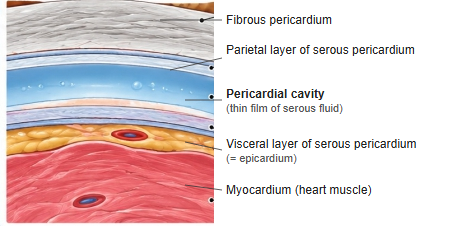
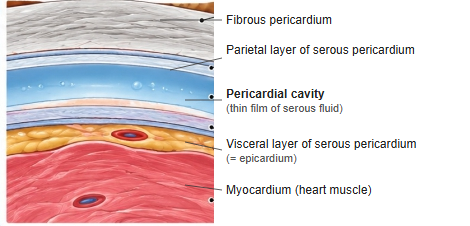
Layers of the pericardium (enlarged section)
Clinical notes
- Cardiac muscle has very little ability to regenerate; after a heart attack (myocardial infarction) the dead muscle is replaced by scar tissue.
References and sources
- Further reading: Myocardium, Wikipedia.