Aditus to mastoid antrum (Latin: aditus ad antrum mastoideum)
Also called Aditus ad antrum or the entrance to mastoid antrum
 Mastoid antrum
 Tympanic cavity (coronal section)
In more detail:
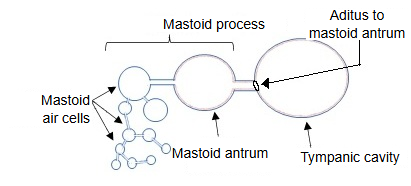
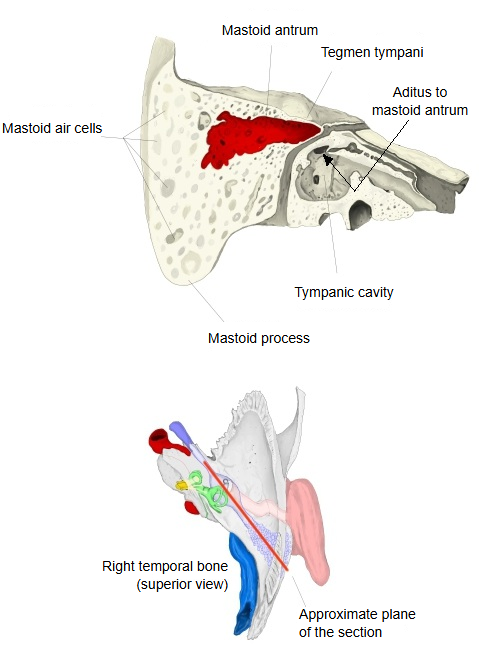
The aditus is a large, irregular opening in the upper part of the posterior wall. It leads backwards from the epitympanic recess into the mastoid antrum, which in turn opens behind and below into the mastoid air cells; these vary greatly in number, size and form. The antrum and the air cells are lined by mucosa continuous with that of the tympanic cavity. On the medial wall of the aditus is a rounded bulge, the prominence of the lateral semicircular canal, above and behind the prominence of the facial canal. Because these spaces are connected, infection of the middle ear can spread through the aditus to the mastoid (mastoiditis).
Reference websites
[Wikipedia]
· Mastoid antrum, Wikipedia.
· Tympanic cavity, Wikipedia.
Related terms
- Mastoid cells
- Tympanic cavity
- Middle ear
- Mastoid process
- Tegmen tympani
- Posterior sinus of tympanic cavity
- Temporal bone
References and sources
- Further reading: Mastoid antrum, Wikipedia.
- Further reading: Tympanic cavity, Wikipedia.
- Federative International Programme for Anatomical Terminology (FIPAT). Terminologia Anatomica, 2nd ed. (TA2), 2019.