Buccal fat pad (Latin: corpus adiposum buccae)
Also called Bichat's fat pad; sucking pad
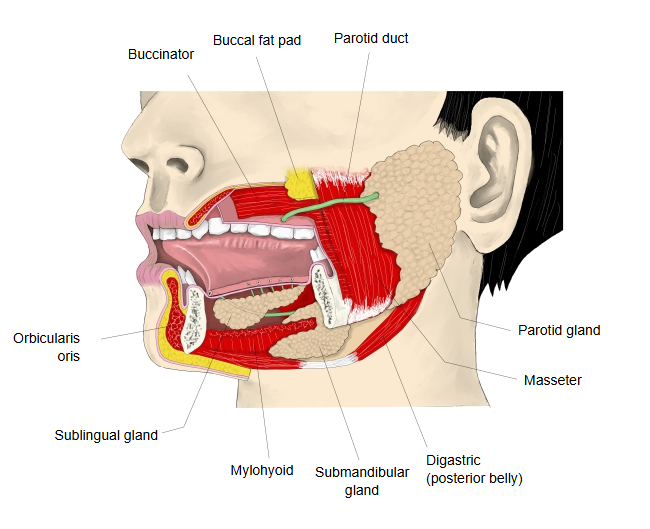
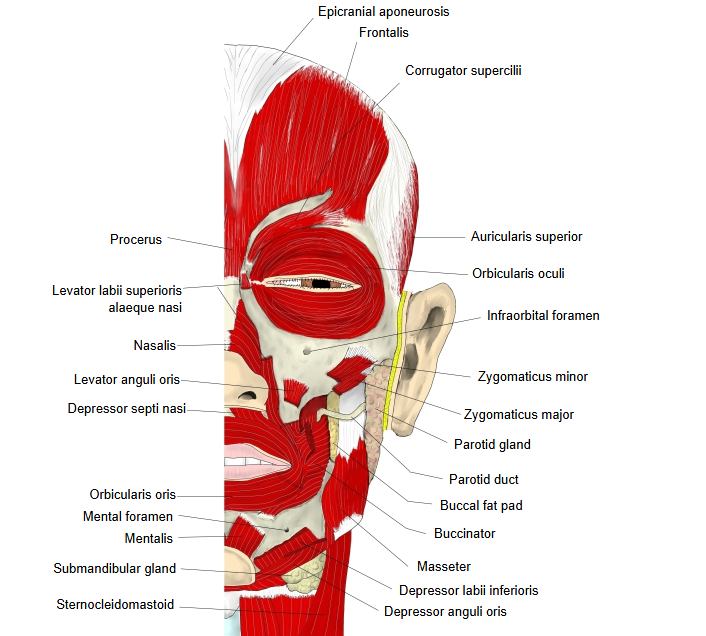
· It is an encapsulated mass of fat in the buccal space: deep to the masseter, zygomaticus major and zygomaticus minor, and superficial to the buccinator.
· The parotid duct from the parotid gland runs across it before piercing the buccinator to open into the mouth at the parotid papilla.
· From its body, extensions reach upward and backward between the muscles of mastication, as far as the temporal fossa and the infratemporal fossa.
· It is a deep fat pad and should not be confused with the superficial fat directly under the skin of the cheek. It is relatively large in infants and gives the cheeks their rounded shape.
· In young people it sits high in the face; with age it tends to shrink and move downward, which is thought to contribute to hollow cheeks and a deeper nasolabial fold.
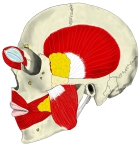 Buccal fat pad on the skull
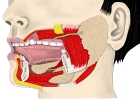 Buccal fat pad and salivary glands
 Muscles of the face
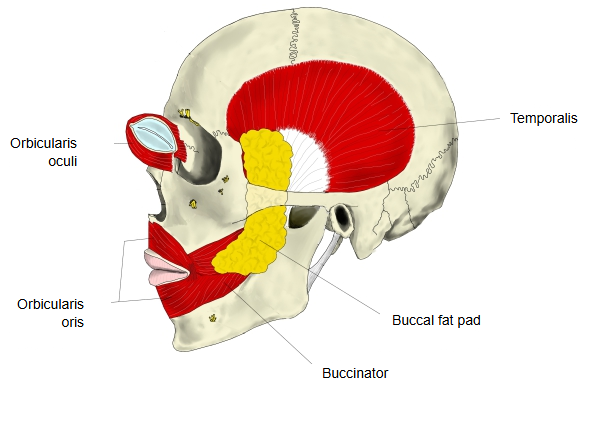
Parts
· It is often divided into anterior, intermediate and posterior lobes. The anterior lobe lies around the parotid duct; the intermediate lobe lies over the maxilla; the posterior lobe extends back toward the ramus of the mandible and up toward the temporalis.
· Four extensions are often named from the body: buccal, pterygoid, pterygopalatine and temporal (superficial and deep).
· The number of parts and their names are not uniform; sources differ.
Function
· In infants it is thought to help sucking by keeping the cheek from collapsing inward.
· It may act as a gliding pad between the muscles of mastication and as a cushion for the facial muscles.
Reference websites
[Wikipedia]
· Buccal fat pad, Wikipedia.
· Buccal space, Wikipedia.
[Websites with illustrations]
· Body and extensions of the buccal fat pad (3B Health)

· Buccal fat pad and its extensions on the skull (Pocket Dentistry)

· Buccal fat pad in the layers of the face (Pocket Dentistry)

Related terms
References and sources
- Further reading: Buccal fat pad, Wikipedia.
- Further reading: Buccal space, Wikipedia.
- Federative International Programme for Anatomical Terminology (FIPAT). Terminologia Anatomica, 2nd ed. (TA2), 2019.