Hormone
- Overview
- History
- Classification (by secreting gland, by chemical structure, by mode of action)
- Gastrointestinal hormones
- Neuroendocrine hormones
- Cytokines / growth factors
- Where it is found
- Related terms
Overview
Hormones are one kind of physiologically active substance.
active
substances
- Physiologically active substances : made in the body: hormones, neurotransmitters, etc.
- From outside the body : medicines; substances in food (caffeine, capsaicin, etc.); substances from microorganisms (penicillin, etc.).
Why do even the classic hormones not have a fixed number? Some hormones have precursors or subunits, and the count changes depending on whether these are counted as one hormone or as several.
History
■ 1902 ■
The British physiologists William Bayliss and Ernest Starling discovered secretin.
In experiments they showed that it is made in the duodenum, carried in the blood and acts on the pancreas (it still works when the nerves are cut).
■ 1905 ■
Starling introduced the word hormone (from Greek, "to set in motion", "to stimulate").
■ Up to the 1950s ■
The so-called classic hormones (secreted by secretory glands and carried in the blood to act on distant organs) were discovered one after another, and endocrinology (the study of endocrine secretion) was established.
■ 1960s–70s ■
As research went on, contradictions in the idea of the classic hormone began to appear.
· Some substances act without travelling in the blood. · The same substance is also used by nerves. · Some act locally. And so on.
■ 1980s–90s ■
The concept of the hormone expanded explosively.
With gastrointestinal hormones, neuropeptides, growth factors, cytokines and others, the boundary between hormones and other physiologically active substances became blurred; definitions still differ between sources.
■ 2000 onwards ■
A compromise view seems to be spreading.
· The classic definition is useful for teaching. · In research the way the substance acts is what counts.
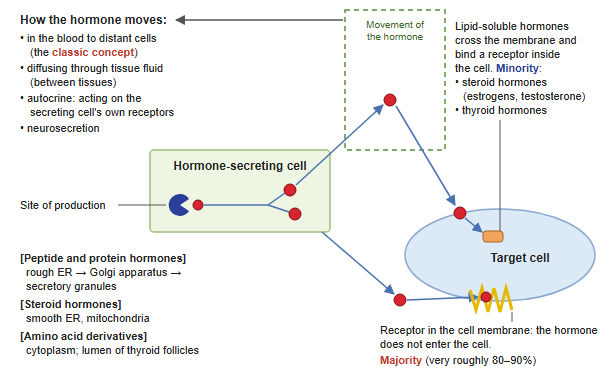
The following four ways of secretion are now becoming the standard for hormones:
1. Endocrine (the classic concept) 2. Paracrine 3. Autocrine 4. Neurosecretion (neuroendocrine)
History of the hormone concept
Classification
There are three basic ways of classifying hormones.
of classic
hormones
- By secreting gland : where it is secreted.
- By chemical structure : what it is made of.
- By mode of action : how it acts (works).
■ Classification by secreting gland ■
glands
- Exocrine glands
- Onto the body surface : sweat glands, sebaceous glands, mammary gland.
- Into the digestive tract : salivary glands, pancreas, liver, gastric glands, duodenal glands.
- Other : nasal glands.
- Endocrine glands : = the endocrine organs, which secrete hormones (Endocrine glands).
- In the brain : pituitary gland, pineal gland.
- In the neck : thyroid gland, parathyroid glands.
- In the abdomen : suprarenal glands, pancreas (pancreatic islets).
- Reproductive organs : gonads (ovary with its corpus luteum, testis); during pregnancy also the placenta.
- Note : the lists try to name as many glands as possible but may not be complete. The pancreas belongs to both groups.
The classic hormones can be classified by their secreting gland as follows.
| Endocrine gland | Part | Hormone | Class | Notes (actions, etc.) |
|---|---|---|---|---|
| Hypothalamus | Releasing and inhibiting factors for the anterior and intermediate lobe hormones | peptides (dopamine: amine) | Promote or inhibit the secretion of the anterior or intermediate lobe hormones of the pituitary. | |
| Pituitary gland | Anterior lobe | Growth hormone (GH) | protein | Promotes growth (protein synthesis; growth of bone, muscle and viscera). |
| Thyroid-stimulating hormone (TSH) | glycoprotein | Promotes secretion of thyroxine (thyroid hormone). | ||
| Adrenocorticotropic hormone (ACTH) | peptide | Promotes secretion of glucocorticoids. | ||
| Gonadotropin: follicle-stimulating hormone (FSH) | glycoprotein | Promotes secretion of follicular hormone (estrogen); promotes maturation in the ovary and testis. | ||
| Gonadotropin: luteinizing hormone (LH) | glycoprotein | Triggers ovulation and formation of the corpus luteum; promotes secretion of male hormone. | ||
| Prolactin | protein | Promotes development of the mammary glands and milk production (the old name "luteotropic hormone" comes from its action on the corpus luteum in rodents). | ||
| Intermediate lobe | Intermedin (melanocyte-stimulating hormone, MSH) | peptide | Melanin synthesis. (The intermediate lobe is rudimentary in adult humans.) | |
| Posterior lobe | Vasopressin (antidiuretic hormone) | peptide | Promotes water reabsorption in the kidney tubules; constricts arterioles. | |
| Oxytocin | peptide | Contraction of the uterine muscle; milk ejection. | ||
| Thyroid gland | Thyroxine (thyroid hormone) | amine (from tyrosine) | Raises metabolism. | |
| Parathyroid glands | Parathyroid hormone (parathormone) | peptide | Acts on bone to release calcium ions into the blood. | |
| Suprarenal gland | Medulla | Adrenaline | amine (catecholamine) | Also a neurotransmitter in ganglia and the nervous system. |
| Cortex | Glucocorticoids | steroid | Promote the making of glucose from protein in the liver. | |
| Mineralocorticoids | steroid | Regulate the concentrations of sodium and potassium ions. | ||
| Pancreas (islets) | β cells | Insulin | peptide | Regulates carbohydrate metabolism; lowers the blood glucose level. |
| α cells | Glucagon | peptide | Raises the blood glucose level (breaks down glycogen in the liver). | |
| Gonads | Testis | Testosterone (male hormone) | steroid | About 95% is made in the testes and 5% in the suprarenal glands. Women also secrete about 5–10% of the male amount. |
| Ovary | Estrogens (female hormones, follicular hormones) | steroid | Form the female characteristics. Men also secrete them (at about the level of women after the menopause). | |
| Progesterone (female hormone, luteal hormone) | steroid | Prepares for and maintains pregnancy. | ||
■ Classification by chemical structure ■
The classic hormones can be classified by their chemical structure as follows.
by chemical
structure
- Peptide and protein hormones : the largest group; amino acids joined in a chain; water-soluble. Examples: oxytocin, insulin, gastrin, erythropoietin.
- Steroid hormones : made from cholesterol; lipid-soluble, pass through the cell membrane; about 20–30 kinds. Examples: cortisol, androgens, estrogens, progesterone.
- Amino acid derivatives : made mainly from a single amino acid, tyrosine or tryptophan. Examples: (nor)adrenaline, dopamine, thyroxine (T4), melatonin.
[Peptide and protein hormones]
Main features
· Made of a sequence of amino acids.
· Water-soluble ⇒ cannot pass through the cell membrane.
· Act on receptors in the cell membrane.
· Their action starts quickly but lasts a relatively short time.
Main hormones
| Peptide and protein hormones (by site) | ||
|---|---|---|
| 1 | Hypothalamus | Thyrotropin-releasing hormone, corticotropin-releasing hormone, gonadotropin-releasing hormone, growth hormone-releasing hormone, somatostatin (the hypothalamus also releases dopamine, an amine) |
| 2 | Anterior pituitary | Growth hormone, prolactin, thyroid-stimulating hormone, adrenocorticotropic hormone, follicle-stimulating hormone, luteinizing hormone |
| 3 | Posterior pituitary | Vasopressin, oxytocin |
| 4 | Pancreas | Insulin, glucagon, somatostatin, pancreatic polypeptide |
| 5 | Gastrointestinal tract | Gastrin, secretin, cholecystokinin, GIP, GLP-1, motilin, somatostatin |
| 6 | Heart | Atrial natriuretic peptide, brain natriuretic peptide |
| 7 | Kidney | Renin, erythropoietin |
| 8 | Adipose tissue | Leptin, adiponectin |
| 9 | Placenta | Human chorionic gonadotropin, human placental lactogen |
| 10 | Others | FGF23 (bone), endothelin (vascular endothelium), cytokines (immune cells) |
[Steroid hormones]
Main features
· Made from cholesterol.
· Lipid-soluble ⇒ can pass through the cell membrane.
· Act on receptors inside the cell.
| Secreted by the suprarenal cortex | 1 | Cortisol |
| 2 | Aldosterone | |
| 3 | Dehydroepiandrosterone (DHEA) | |
| Gonads | 1 | Testosterone (testis) |
| 2 | Estrogens (ovary) | |
| 3 | Progesterone (ovary, placenta) | |
| Placenta | 1 | Estrogens |
| 2 | Progesterone |
[Amino acid derivatives]
Main features
· Made from a single amino acid (mainly tyrosine or tryptophan).
· Some are water-soluble and some lipid-soluble ⇒ their receptors are in different places (catecholamines act on receptors in the cell membrane, thyroid hormones on receptors inside the cell).
· The time until they act differs: catecholamines are fast (seconds to minutes), thyroid hormones slow (hours to days).
| Catecholamines (from tyrosine) | 1 | Adrenaline |
| 2 | Noradrenaline | |
| 3 | Dopamine | |
| Thyroid hormones (from tyrosine) | 1 | Thyroxine (T4) |
| 2 | Triiodothyronine (T3) | |
| Indoleamines (from tryptophan) | 1 | Melatonin (pineal gland) |
■ Classification by mode of action ■
by mode
of action
- Endocrine : the way the classic hormones are secreted: carried in the blood to target cells throughout the body.
- Paracrine : diffuses through the extracellular fluid to nearby cells.
- Autocrine : the secretion acts on receptors of the secreting cell itself.
- Neuroendocrine : made by the cell body of a nerve cell and released at the axon terminal ⇒ blood ⇒ whole body.
[Endocrine]
The case of the classic hormones, which reach distant target cells (or tissues) in the blood.
Endocrine action
Typical examples
| Hormone | Main site of secretion | Action | |
|---|---|---|---|
| 1 | Insulin | Pancreas (β cells of the islets of Langerhans) | Lowers blood glucose; promotes glucose uptake |
| 2 | Glucagon | Pancreas (α cells) | Raises blood glucose |
| 3 | Cortisol | Suprarenal cortex | Stress response; regulation of metabolism |
| 4 | Thyroid hormones | Thyroid gland | Raise metabolism; growth and development |
| 5 | Aldosterone | Suprarenal cortex | Retention of sodium; regulation of blood pressure |
[Paracrine]
· Does not enter the blood but diffuses locally in the extracellular fluid (from neighbouring cells to cells within the same tissue); the distance is about 10 µm to a few hundred µm.
· It is quite usual for cells of the same kind to be the target cells. ⇒ Neighbouring cells keep regulating one another, using stimulation (promotion) and inhibition at the same time.
· The great majority are water-soluble hormones ⇒ hormones of the membrane-receptor type. Exceptions: nitric oxide (NO), prostaglandins and others are lipid-soluble.
Paracrine action
Typical examples
| Hormone | Main site of secretion | Action | |
|---|---|---|---|
| 1 | Epidermal growth factor | Epithelial cells | Cell proliferation, wound healing |
| 2 | Vascular endothelial growth factor | Tissues short of oxygen | Formation of new blood vessels |
| 3 | Nitric oxide | Vascular endothelium | Widening of blood vessels |
| 4 | Prostaglandins | Many tissues | Inflammation, regulation of blood flow |
| 5 | Gastrointestinal somatostatin | Endocrine cells of the gastrointestinal tract | Inhibits the gastrointestinal hormones |
[Autocrine]
· The cell receives the hormone it has secreted with its own receptors; in other words, the secreting cell = the target cell.
· There are no cells that use only autocrine secretion; if the secretion acts on the receptors of other cells, it is paracrine.
· Most are water-soluble.
Typical examples
| Hormone | Main site of secretion | Action | |
|---|---|---|---|
| 1 | Interleukin-2 | Activated T cells | Promotes the proliferation of the T cells themselves |
| 2 | Insulin-like growth factor | Many cells | Promotes the cell's own growth and survival |
| 3 | Transforming growth factor β | Immune cells and others | Inhibits the cell's own proliferation; regulates differentiation |
| 4 | Tumour necrosis factor α | Macrophages | Self-amplification of the inflammatory reaction |
| 5 | Epidermal growth factor | Tumour cells and others | Promotes the cell's own proliferation |
[Neuroendocrine]
· Made in the cytoplasm of the nerve cell body, carried along the axon and secreted at the axon terminal.
· The secreted hormone enters a nearby blood vessel and is carried by the blood throughout the body (neurosecretion).
· Most are water-soluble.
from the
axon terminal
- Neurotransmitter : crosses the synaptic cleft to the postsynaptic cell.
- Neuroendocrine hormone : enters the nearest blood vessel and is carried in the blood to distant target organs.
- Neuropeptide : diffuses through the extracellular fluid to nearby cells and tissues.
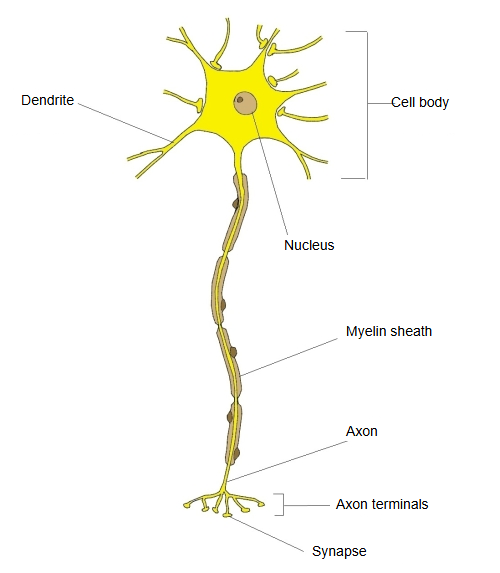
Axon: carried
Axon terminal: secreted (click to enlarge)
Typical examples
| Hormone | Main site of secretion | Action | |
|---|---|---|---|
| 1 | Vasopressin (ADH) | Hypothalamus → posterior pituitary | Water reabsorption; maintenance of blood pressure |
| 2 | Oxytocin | Hypothalamus → posterior pituitary | Uterine contraction; milk ejection |
| 3 | Corticotropin-releasing hormone (CRH) | Hypothalamus | Promotes ACTH secretion |
| 4 | Thyrotropin-releasing hormone (TRH) | Hypothalamus | Promotes TSH and prolactin secretion |
| 5 | Gonadotropin-releasing hormone (GnRH) | Hypothalamus | Promotes LH and FSH secretion |
Gastrointestinal hormones
· The endocrine cells make up only about 0.5–2% of the cells of the mucosal epithelium of the gastrointestinal tract, but their role is large. Stomach and duodenum ⇒ relatively many; distal small intestine and large intestine ⇒ somewhat fewer.
· Almost all gastrointestinal hormones are peptide and protein hormones. An exception is serotonin (5-HT), an amine made from tryptophan.
Main hormones
| Hormone | Main site of secretion | Main actions | |
|---|---|---|---|
| 1 | Gastrin | Pyloric antrum of the stomach (G cells) | Promotes gastric acid secretion, growth of the gastric mucosa and gastric movement |
| 2 | Secretin | Duodenum (S cells) | Promotes bicarbonate secretion from the pancreas and bile ducts; inhibits gastric acid secretion |
| 3 | Cholecystokinin | Duodenum and jejunum (I cells) | Promotes secretion of pancreatic digestive enzymes and contraction of the gallbladder; slows gastric emptying; induces satiety |
| 4 | GIP | Duodenum and jejunum (K cells) | Promotes insulin secretion (incretin action); inhibits gastric acid secretion |
| 5 | GLP-1 | Ileum and large intestine (L cells) | Promotes insulin secretion; inhibits glucagon; slows gastric emptying; reduces appetite |
| 6 | GLP-2 | Ileum and large intestine (L cells) | Promotes growth of the intestinal mucosa; maintains the barrier function of the intestine |
| 7 | Motilin | Duodenum and jejunum | Promotes gut movement in the fasting state (migrating motor complex, MMC) |
| 8 | Somatostatin | Stomach and intestine (D cells), pancreatic δ cells | Inhibits the secretion of gastric acid, gastrointestinal hormones and pancreatic hormones (a general inhibitor) |
| 9 | Peptide YY | Ileum and large intestine (L cells) | Slows gastric emptying; reduces appetite; inhibits gut movement |
| 10 | Neurotensin | Ileum and colon | Inhibits gastric acid secretion; increases intestinal blood flow; regulates fat absorption |
| 11 | Vasoactive intestinal peptide | Enteric nerve plexuses (neuroendocrine cells) | Promotes secretion of intestinal juice; relaxes smooth muscle; widens blood vessels; inhibits gastric acid secretion |
Neuroendocrine hormones
from the
axon terminal
- Neurotransmitter : crosses the synaptic cleft to the postsynaptic cell.
- Neuroendocrine hormone : enters the nearest blood vessel and is carried in the blood to distant target organs.
- Neuropeptide : diffuses through the extracellular fluid to nearby cells and tissues.
Axon: carried
Axon terminal: secreted (click to enlarge)
Main hormones
| Name | Site of the secreting neurons | Main actions | |
|---|---|---|---|
| Hypothalamus (posterior pituitary system: released directly into the blood) | |||
| 1 | Vasopressin (antidiuretic hormone) | Hypothalamus (supraoptic and paraventricular nuclei) | Promotes water reabsorption in the kidney; regulates blood pressure |
| 2 | Oxytocin | Hypothalamus (supraoptic and paraventricular nuclei) | Uterine contraction; milk-ejection reflex |
| Hypothalamus (system controlling the anterior pituitary: through the portal vessels) | |||
| 1 | Corticotropin-releasing hormone | Hypothalamus (paraventricular nucleus) | Promotes secretion of adrenocorticotropic hormone |
| 2 | Thyrotropin-releasing hormone | Hypothalamus (paraventricular nucleus) | Promotes secretion of thyroid-stimulating hormone (and prolactin) |
| 3 | Gonadotropin-releasing hormone | Hypothalamus (preoptic area, arcuate nucleus) | Promotes secretion of luteinizing hormone and follicle-stimulating hormone |
| 4 | Growth hormone-releasing hormone | Hypothalamus (arcuate nucleus) | Promotes GH secretion |
| 5 | Somatostatin | Hypothalamus (periventricular nucleus) | Inhibits secretion of growth hormone and thyroid-stimulating hormone |
| 6 | Dopamine (prolactin-inhibiting hormone, PIH) | Hypothalamus (arcuate (infundibular) nucleus) | Inhibits prolactin secretion |
| Pineal gland | |||
| 1 | Melatonin | Pineal gland | Regulates the circadian rhythm; sleep |
| Other neuropeptides with hormone-like actions (examples) | |||
| 1 | β-endorphin | Hypothalamus, pituitary | Pain relief; stress response |
| 2 | α-MSH | Hypothalamus, pituitary | Pigmentation; regulation of eating |
Cytokines / growth factors
· Cytokines: secreted mainly by immune cells; they regulate and control the immune reactions. Examples: interleukins, interferons.
· Growth factors: substances that tell cells to multiply, repair and maintain themselves. Examples: epidermal growth factor, nerve growth factor.
Main hormones
| Name | Main site of secretion | Mode of secretion | Main actions | |
|---|---|---|---|---|
| Cytokines | ||||
| 1 | Interleukin-6 | Immune cells, fat cells, skeletal muscle | autocrine, paracrine, endocrine | Inflammation; acute-phase reaction in the liver; regulation of metabolism |
| 2 | Tumour necrosis factor α | Macrophages, fat cells | paracrine, endocrine | Promotes inflammation; fever; insulin resistance |
| 3 | Interferon γ | T cells, NK cells | paracrine, endocrine | Activates macrophages; boosts immunity |
| 4 | Transforming growth factor β | Many cells | autocrine, paracrine (sometimes endocrine) | Inhibits proliferation; suppresses immunity; tissue repair |
| Growth factors | ||||
| 1 | Insulin-like growth factor 1 | Liver (mainly) | endocrine | Promotes growth of the whole body and development of bone and muscle |
| 2 | Vascular endothelial growth factor | Tissues short of oxygen, tumour cells | paracrine (exceptionally endocrine) | Formation of new blood vessels |
| 3 | Fibroblast growth factor 21 | Liver, adipose tissue | endocrine | Regulates glucose and fat metabolism; energy balance |
| 4 | Leptin | Fat cells | endocrine | Reduces appetite; regulates energy |
Where it is found
Related terms
- Endocrine glands
- Pancreatic islets
- Pituitary gland
- Thyroid gland
- Suprarenal gland
- Enteroendocrine cell
References and sources
- Further reading: Hormone, Wikipedia.
- Further reading: Endocrine system, Wikipedia.
- Federative International Programme for Anatomical Terminology (FIPAT). Terminologia Anatomica, 2nd ed. (TA2), 2019.