Cytokine
A protein secreted by cells, especially cells of the immune system, that carries signals to other cells.
More details
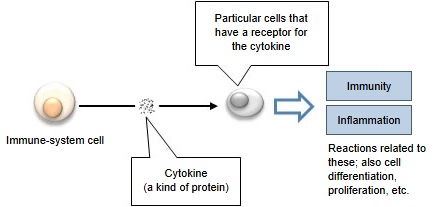
Cytokines are small proteins secreted mainly by cells of the immune system, although many other cells, such as endothelial cells and fibroblasts, also release them. A cytokine passes information only to particular cells that have a receptor for it.
The cells that receive the signal carry out actions related above all to immunity and inflammation, but also cell differentiation, proliferation and cell death (apoptosis).
There are many kinds. Older names describe their source: cytokines from monocytes were called monokines, and those from lymphocytes lymphokines.
The main groups are the following:
| 1 | Interleukins | IL |
| 2 | Interferons | IFN |
| 3 | Tumour necrosis factor-α | TNF-α |
| 4 | Colony-stimulating factors | CSF |
| 5 | Growth factors (often treated as a separate group, which overlaps with the cytokines) | GF |
Reference websites
[Wikipedia]
· Cytokine, Wikipedia.
Related terms
References and sources
- Further reading: Cytokine, Wikipedia.
- Federative International Programme for Anatomical Terminology (FIPAT). Terminologia Anatomica, 2nd ed. (TA2), 2019.