Lymphocyte (Latin: lymphocytus)
One of the white blood cells: small, round cells with a large nucleus that protect our body by attacking bacteria, viruses and other invaders; they carry out specific (adaptive) immune responses and some innate defence.
| Location | Group | Name | Share | Notes |
|---|---|---|---|---|
| In the peripheral blood | Granulocytes | Neutrophils | 50–75% (all granulocytes) | About 90–95% of the granulocytes |
| Eosinophils | About 2–5% of the granulocytes | |||
| Basophils | 1% or less of the granulocytes | |||
| Lymphocytes | 20–40% | Kinds: NK cells, B cells, T cells | ||
| Monocytes | 3–6% | The largest of the white blood cells | ||
| In the tissues | Dendritic cells | less than 0.1–1% | Found throughout the body, beginning with the subcutaneous tissue | |
More details
Lymphocytes make up 20–40% of the white blood cells in the peripheral blood, but most of them live in the lymphoid tissues: the lymph nodes, spleen, thymus, tonsils and the lymphoid tissue of mucous membranes. Their features are:
| 1 | Size | 6–14 µm (6/1000 mm to 14/1000 mm), a little smaller than the other white cells. Small and large lymphocytes are sometimes distinguished, but there is no fixed size limit between them. For comparison: neutrophil 12–15 µm, eosinophil 13–20 µm, basophil 10–16 µm, monocyte 15–20 µm. |
| 2 | Life span | From a few days to months, sometimes years; long-lived memory cells keep the record of earlier infections. |
| 3 | Formation | White blood cells, red blood cells, platelets and the other blood cells all arise from the hematopoietic stem cells of the red bone marrow and leave the bone marrow in the course of their differentiation. B cells and NK cells mature in the bone marrow; T cells leave it as precursors and mature in the thymus. The bone marrow and the thymus are the primary lymphoid organs. Mature lymphocytes then settle in the secondary lymphoid organs (lymph nodes, spleen, tonsils, mucosal lymphoid tissue), where they meet antigens and multiply. |
| 4 | Kinds | Lymphocytes can be divided into three kinds: T cells (= T lymphocytes; about 60–70%; the majority in the blood): cell-mediated immunity, such as removing infected cells and tumour cells, and helper cells that direct other immune cells. B cells (= B lymphocytes; about 10–20%): humoral immunity; when activated they become plasma cells that secrete antibodies. NK cells (= natural killer cells; about 10–15%): non-specific (innate) immunity; they kill virus-infected cells and tumour cells without needing a specific antigen first. |
| 5 | Others | · A large, round, dark nucleus fills most of the cell and leaves only a thin rim of cytoplasm. · They move very actively, crawling with amoeboid movements, and circulate between the blood, the tissues and the lymph. 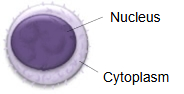 |
Note: the diagram below is simplified.
Formation and distribution of lymphocytes
Bone marrow
Lymphoid precursor
Thymus
T precursormatures
T lymphocyte
Lymph nodes, spleenwhole body
Bone marrow
Lymphoid precursormatures
B lymphocyte
Lymph-node cortex, spleenwhite pulp
Bone marrow
Lymphoid precursormatures
NK cell
Throughout the bodyblood, spleen, liver, lungs, lymph nodes
Red bone marrow: especially in the pelvis, sternum, vertebrae and ribs. The bone marrow and the thymus are the primary lymphoid organs.
Reference websites
[Wikipedia]
· Lymphocyte, Wikipedia.
Related terms
- Lymphoid tissue
- White blood cell
- B lymphocyte
- Plasma cell
- Granulocyte
- Lymphoid organ
- Lymph node
- Hematopoietic stem cell
References and sources
- Further reading: Lymphocyte, Wikipedia.
- Federative International Programme for Anatomical Terminology (FIPAT). Terminologia Anatomica, 2nd ed. (TA2), 2019.