Monocyte (Latin: monocytus)
One of the white blood cells that protect the body against invaders such as viruses and bacteria, and against cancer cells.
More details
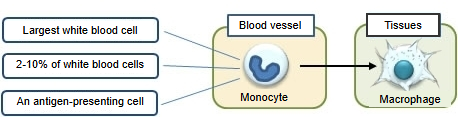
The largest of the white blood cells (about 15-22 µm across; sources differ), with a large nucleus that is often indented (kidney- or horseshoe-shaped). Monocytes make up about 2-10% of the white blood cells in the blood. Together with the lymphocytes they are counted as mononuclear leukocytes (agranulocytes), in contrast to the granulocytes.
It is one of the antigen-presenting cells and a strong phagocyte: it takes in foreign material, presents fragments of it (antigen presentation) to helper T cells and so drives the immune response.
It leaves the blood vessels, moves into the tissues and there becomes a macrophage.
Monocytes are produced from hematopoietic stem cells in the red bone marrow and circulate in the blood for about one to three days before passing through the vessel wall. In the tissues they become macrophages, and some become dendritic cells; osteoclasts also come from the same line.
Related terms
- White blood cell
- Macrophage
- Dendritic cell
- Granulocyte
- Lymphocyte
- Hematopoietic stem cell
- Osteoclast
References and sources
- Further reading: Monocyte, Wikipedia.
- Federative International Programme for Anatomical Terminology (FIPAT). Terminologia Anatomica, 2nd ed. (TA2), 2019.