Immune system
The immune system is the system that protects our body by attacking invaders such as bacteria and viruses that have entered it, and abnormal cells such as cancer cells.
More details
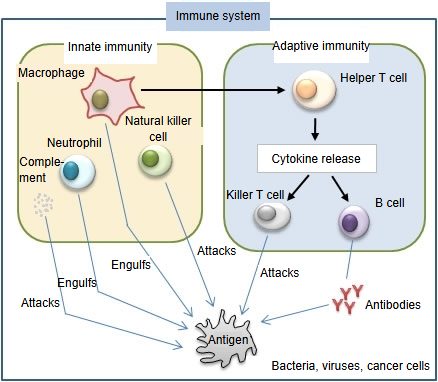
There are two kinds of immunity: innate immunity and acquired (adaptive) immunity. Innate immunity acts against an invader first; if it cannot deal with it, acquired immunity takes over.
| 1 | Innate immunity | Natural immunity: the immunity present from birth that attacks invaders and abnormal cells such as cancer cells. It is made up of the complement system, natural killer cells, macrophages and the granulocytes, such as the neutrophils. |
| 2 | Acquired immunity | Adaptive immunity: not present from birth, it is gained as various foreign substances (antigens) enter the body. It is carried out by lymphocytes: helper T cells, killer T cells, and B cells that become antibody-secreting plasma cells. |
When invaders such as bacteria or viruses (antigens) enter the body, innate immunity acts first; if it is not enough, acquired immunity takes over.
Acquired immunity also leaves memory cells, which respond quickly the next time the same antigen enters the body.
Immune cells form in the red bone marrow and gather in the lymphoid organs: the thymus, spleen, lymph nodes, tonsils and the lymphoid tissue of mucous membranes.
Reference websites
[Wikipedia]
· Immune system, Wikipedia.
· Innate immune system, Wikipedia.
· Adaptive immune system, Wikipedia.
Related terms
- Natural killer cell
- Lymphocyte
- White blood cell
- Macrophage
- Neutrophil
- B lymphocyte
- Lymphoid organ
- Primary lymphoid organ
References and sources
- Further reading: Immune system, Wikipedia.
- Federative International Programme for Anatomical Terminology (FIPAT). Terminologia Anatomica, 2nd ed. (TA2), 2019.