Endolymphatic sac (Latin: saccus endolymphaticus)
· Size: roughly 1 cm long and 5–8 mm wide (sources differ).
· It lies outside the external opening of the vestibular aqueduct and extends downwards and laterally. It is the only part of the membranous labyrinth that lies outside the bone, next to the cranial cavity.
· Together with the endolymphatic duct, which has the same functions, the sac is thought to:
· absorb and secrete endolymph, take up particles (phagocytosis) and take part in the immune defence of the inner ear.
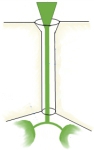 Utriculosaccular duct to endolymphatic sac (schematic)
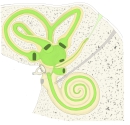 Bony and membranous labyrinth
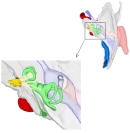 Right inner ear (from above)
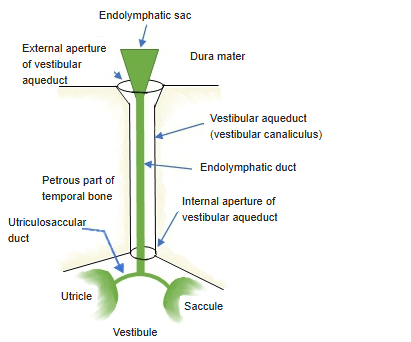
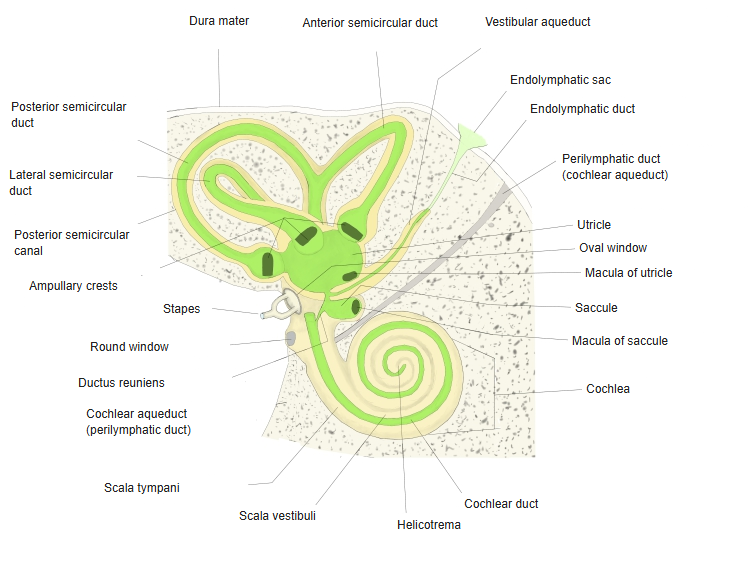
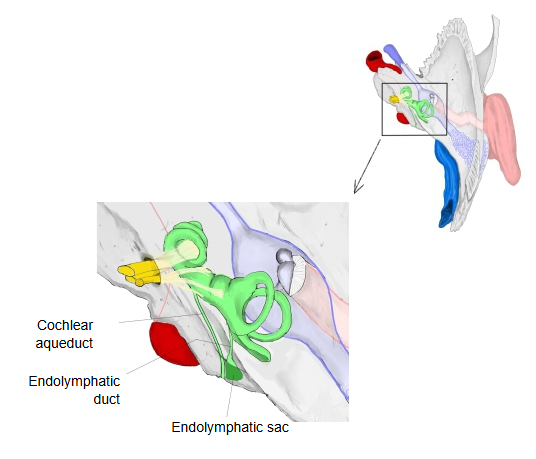
At its end the endolymphatic duct widens into the endolymphatic sac, a fairly large, flat pouch. It lies outside the opening of the vestibular aqueduct, against the posterior surface of the petrous part of the temporal bone, between the two layers of the dura mater, and extends downwards and laterally.
The endolymphatic duct leaves the posterior wall of the saccule, is joined by the utriculosaccular duct (from the utricle), passes along the vestibular aqueduct and ends as this blind pouch in contact with the dura mater. Tumours of the endolymphatic sac are very rare.
Reference websites
[Wikipedia]
· Endolymphatic sac, Wikipedia.
· Vestibular aqueduct, Wikipedia.
[Websites with illustrations]
· The membranous labyrinth (Gray's Anatomy, fig. 924) (Wikimedia Commons)

Related terms
- Endolymphatic duct
- Endolymphatic space
- Membranous labyrinth
- Saccule
- Utricle
- Dura mater
- Petrous part
- Temporal bone
- Internal ear
References and sources
- Further reading: Endolymphatic sac, Wikipedia.
- Further reading: Vestibular aqueduct, Wikipedia.
- Federative International Programme for Anatomical Terminology (FIPAT). Terminologia Anatomica, 2nd ed. (TA2), 2019.