Vestibular aqueduct (Latin: aqueductus vestibuli)
Also called Aqueduct of vestibule or the vestibular canaliculus
About the name "internal aperture of the vestibular aqueduct"
Only a few sources use the name "internal aperture of the vestibular aqueduct", so it does not seem to be in general use. Rauber-Kopsch's textbook of anatomy calls it the vestibular opening of the vestibular canaliculus.
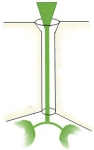 Utriculosaccular duct to endolymphatic sac (model diagram)
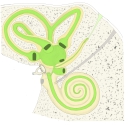 Bony and membranous labyrinth
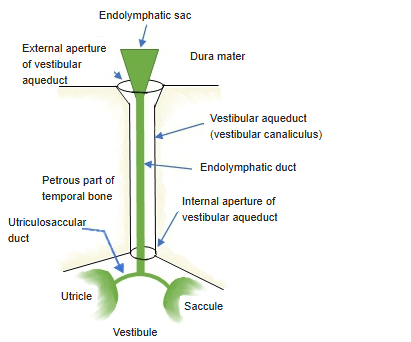
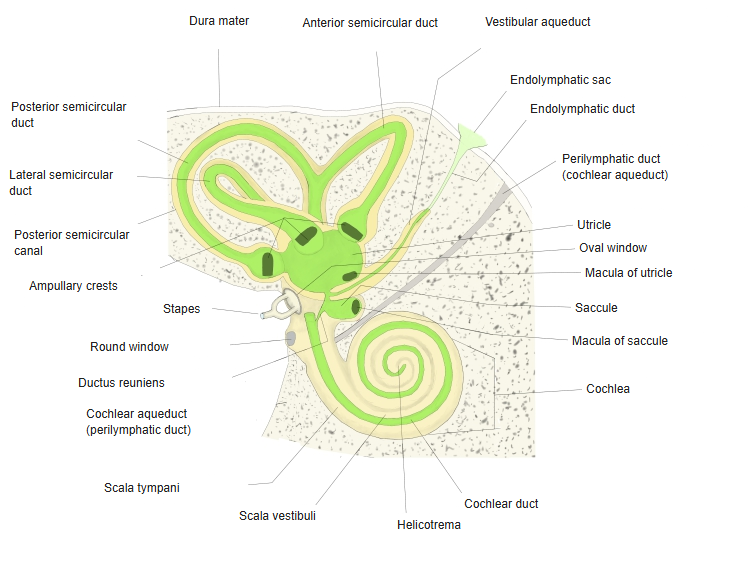
The vestibular aqueduct begins at a small opening in the back of the medial wall of the vestibule, below the elliptical recess. It curves backwards and ends at the external aperture, a slit on the posterior surface of the petrous part, behind and lateral to the internal acoustic opening. It contains the endolymphatic duct and a small vein; the duct ends beyond the aperture as the endolymphatic sac, between the layers of the dura mater. An abnormally wide vestibular aqueduct is a recognised cause of hearing loss in children.
Reference websites
[Wikipedia]
· Vestibular aqueduct, Wikipedia.
[Websites with illustrations]
· Interior of the right osseous labyrinth (Gray's Anatomy, fig. 921) (Wikimedia Commons)

· Left temporal bone, inner surface (Gray's Anatomy, fig. 138) (Wikimedia Commons)

· The inner ear: bony and membranous labyrinth (TeachMeAnatomy)
Related terms
- External aperture of vestibular aqueduct
- Internal aperture of vestibular aqueduct
- Vestibular ganglion
- Pyramid of vestibule
- Vestibular crest
- Scala vestibuli
- Endolymphatic duct
- Endolymphatic sac
- Internal ear
- Petrous part
- Vestibule
- Aqueduct of cochlea
- Bony labyrinth
References and sources
- Further reading: Vestibular aqueduct, Wikipedia.
- Federative International Programme for Anatomical Terminology (FIPAT). Terminologia Anatomica, 2nd ed. (TA2), 2019.