Equator of lens (Latin: equator lentis)
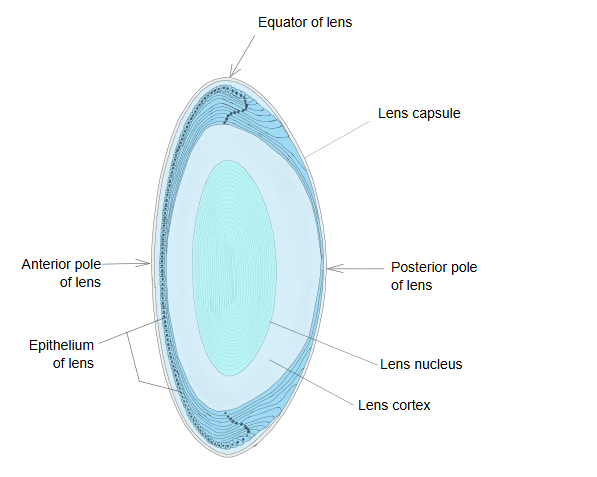
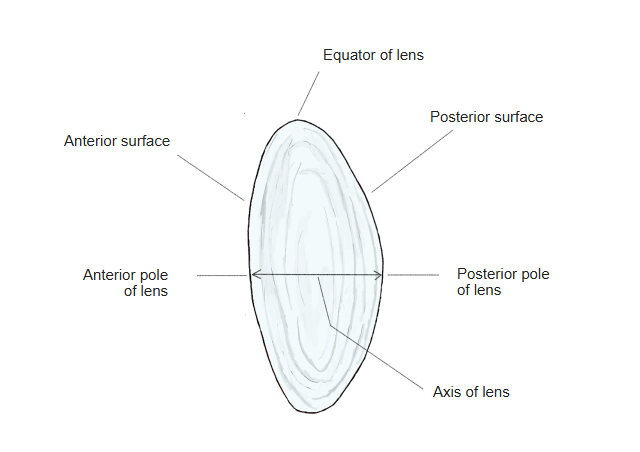
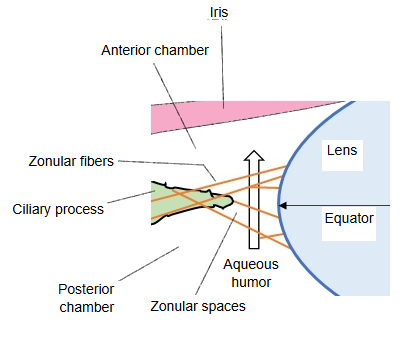
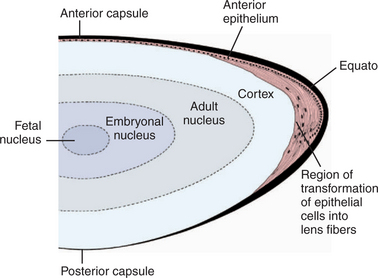
The equator of the lens is the rounded rim where the front and back surfaces of the lens meet; it is part of the attachment of the ciliary zonule.
Lens: the clear, biconvex body behind the irisCiliary zonule: fine fibres stretched between the ciliary processes and the lens
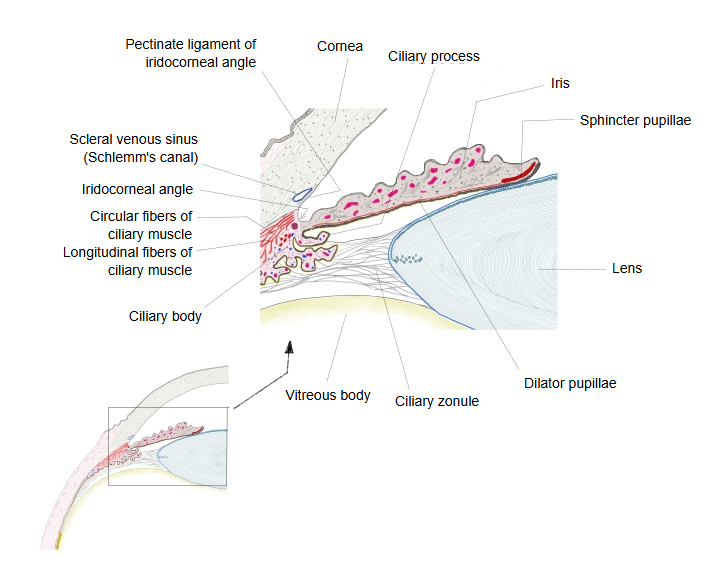
The equator marks the widest part of the lens, about 9-10 mm across in the adult. The zonular fibres attach to the lens capsule on the equator and just in front of and behind it. The equator lies close to the ciliary processes of the ciliary body, separated from them by a narrow gap. Near the equator the cells of the lens epithelium divide and lengthen into new lens fibres; this growth zone adds fibres to the lens throughout life.
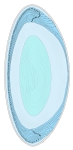 Lens (section) 1
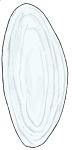 Lens (section) 2
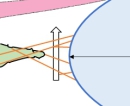 Ciliary zonule (diagram)
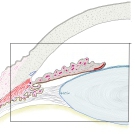 Iris and ciliary body (section)
Reference websites
[Wikipedia]
· Lens (vertebrate anatomy), Wikipedia.
[Websites with illustrations]


Related terms
- Lens nucleus
- Lens cortex
- Posterior pole of lens
- Axis of lens
- Radii of lens
- Lens
- Ciliary zonule
- Ciliary processes
- Ciliary body
- Equator of eyeball
- Posterior chamber of eyeball
References and sources
- Further reading: Lens (vertebrate anatomy), Wikipedia.
- Federative International Programme for Anatomical Terminology (FIPAT). Terminologia Anatomica, 2nd ed. (TA2), 2019.