Lens nucleus (Latin: nucleus lentis)
· There is no clear boundary between the lens nucleus and the lens cortex around it. The nucleus holds less water than the cortex and is therefore harder.
of the
lens
- Lens capsule : a transparent elastic membrane that wraps the whole lens; thickest at the front, about one third as thick at the back.
- Lens substance : the contents of the capsule.
- Epithelium of lens : a simple cuboidal epithelium found only on the front of the lens, under the capsule.
- Lens cortex : the softer outer part, made of lens fibers.
- Lens nucleus : the firmer central part, also made of lens fibers; there is no sharp border between cortex and nucleus. The less water a part holds, the firmer it is.
- Lens fibers : long cells, flattened and hexagonal in cross-section; young fibers have a nucleus, the older central fibers lose it. They are divided into main, central and transitional fibers.
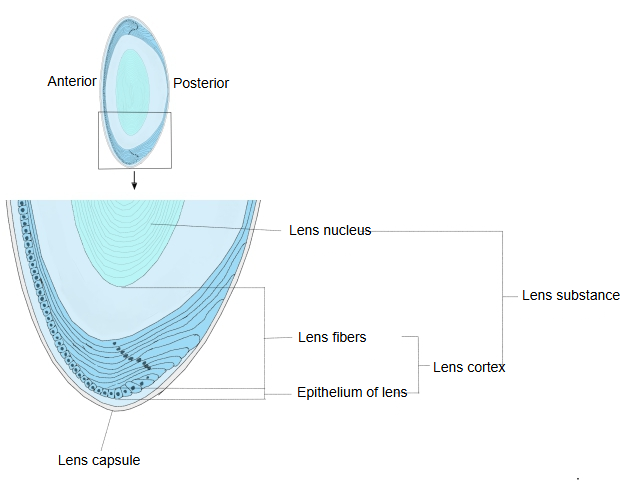
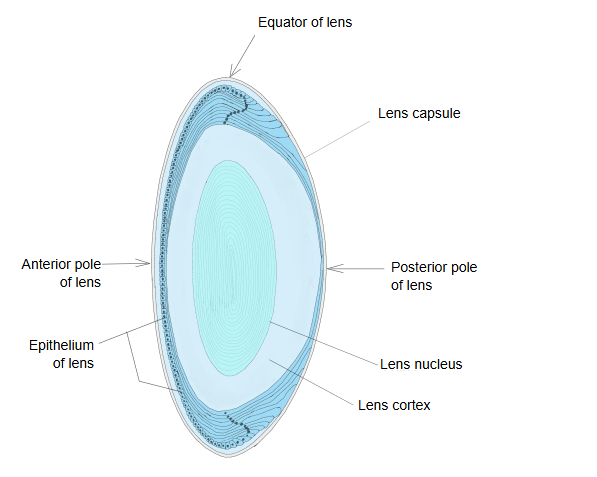
The lens grows throughout life by adding new fibers at its surface, so the nucleus is made of the oldest fibers, some of them laid down before birth. Its fibers have lost their nuclei and organelles and are tightly packed, which keeps the lens transparent. The nucleus becomes larger, harder and less elastic with age; this is one reason the lens can no longer change shape well for near vision (presbyopia). Clouding of the nucleus (nuclear cataract) is a common type of age-related cataract. Sources differ in how they divide the nucleus into layers by age (embryonic, fetal, infantile and adult nucleus) and in where they set its border with the cortex.
Reference websites
[Wikipedia]
· Lens (vertebrate anatomy), Wikipedia.
Related terms
- Lens cortex
- Posterior pole of lens
- Axis of lens
- Equator of lens
- Radii of lens
- Lens
- Ciliary zonule
- Eyeball
- Ciliary body
- Aqueous humor
- Vitreous body
References and sources
- Further reading: Lens (vertebrate anatomy), Wikipedia.
- Further reading: Cataract, Wikipedia.
- Federative International Programme for Anatomical Terminology (FIPAT). Terminologia Anatomica, 2nd ed. (TA2), 2019.