Lens fiber (Latin: fibra lentis)
Also called: lens fibre; lens fibers (plural)
· Their length varies (surface fibers are about 7–10 mm long); they are about 7–12 µm wide and 2.5–5.5 µm thick (sources differ).
· The fibers are packed tightly in concentric layers, like the layers of an onion, and are joined by interlocking edges and many gap junctions. The narrow spaces between them carry water and metabolites through the lens.
· The living lens has no blood vessels and no nerves.
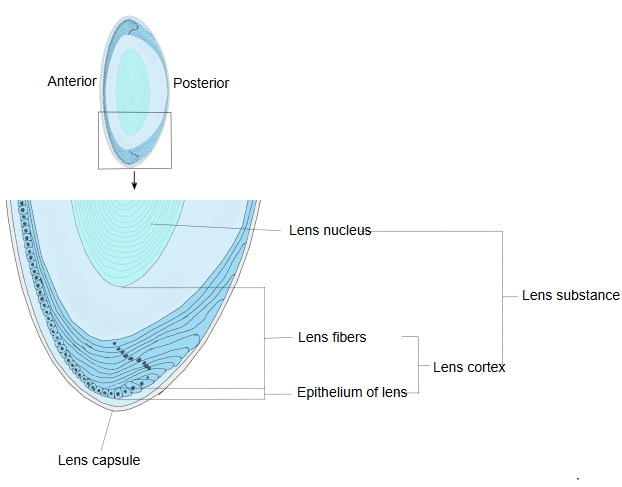
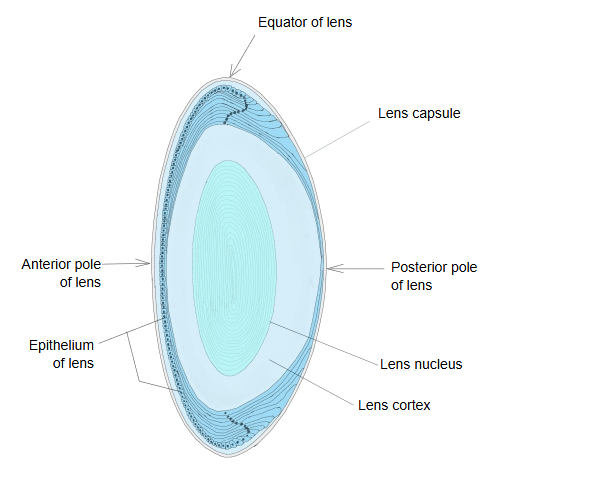
· New fibers form throughout life from the lens epithelium at the equator. As they lengthen they lose their nucleus and organelles and fill with transparent proteins (crystallins). The ends of the fibers of each layer meet along the lens sutures at the front and back of the lens; no fiber runs from one pole to the other. Young fibers with nuclei form the lens cortex, and older fibers without nuclei the lens nucleus.
of the
lens
- Lens capsule : a transparent elastic membrane that wraps the whole lens; thickest at the front, about one third as thick at the back.
- Lens substance : the contents of the capsule.
- Epithelium of lens : a simple cuboidal epithelium found only on the front of the lens, under the capsule.
- Lens cortex : the softer outer part, made of lens fibers.
- Lens nucleus : the firmer central part, also made of lens fibers; there is no sharp border between cortex and nucleus.
- Lens fibers : long cells, flattened and hexagonal in cross-section; young fibers have a nucleus, the older central fibers lose it.
fibers
- Principal fibers : form the lens cortex; straight edges and a regular arrangement. They have a nucleus, which lies near the equator (about halfway along the fiber).
- Central fibers : irregular in shape with jagged edges; they occupy the centre of the lens. No nucleus.
- Transitional fibers : lie just outside the central fibers; they have already lost their nuclei by late fetal life.
- Note : The central and transitional fibers have no nucleus and together form the lens nucleus.
Reference websites
[Wikipedia]
· Lens (vertebrate anatomy), Wikipedia.
Related terms
References and sources
- Further reading: Lens (vertebrate anatomy), Wikipedia.
- Federative International Programme for Anatomical Terminology (FIPAT). Terminologia Anatomica, 2nd ed. (TA2), 2019.