Posterior pole of lens (Latin: polus posterior lentis)
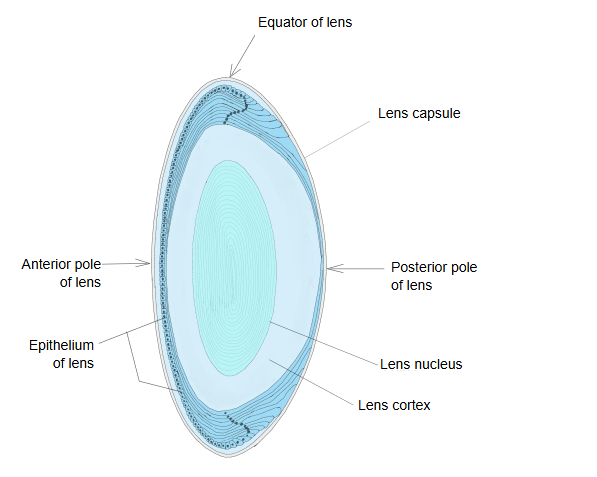
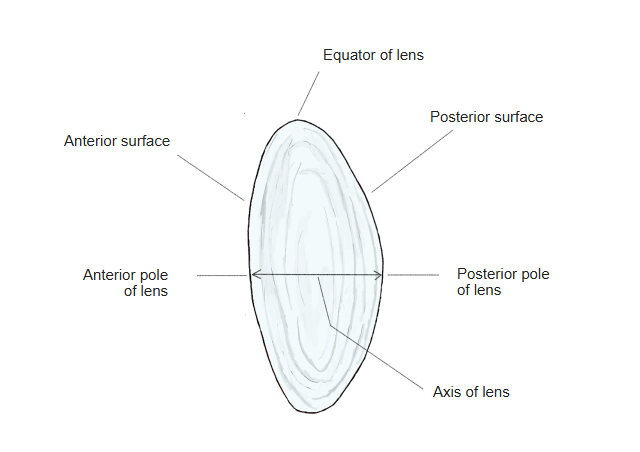
The posterior pole of the lens is the central point of the back surface of the lens; the central point of the front surface is called the anterior pole of the lens.
Lens: a transparent body shaped like a biconvex lens
The straight line joining the two poles is the axis of the lens; it lies on the optic axis of the eyeball. The posterior surface is more strongly curved than the anterior surface, so the posterior pole sits at the top of a steeper curve. The posterior pole faces the hyaloid fossa on the front of the vitreous body, and the lens capsule is thinnest here.
Reference websites
[Wikipedia]
· Lens (vertebrate anatomy), Wikipedia.
Related terms
- Lens nucleus
- Lens cortex
- Axis of lens
- Equator of lens
- Radii of lens
- Lens
- Eyeball
- Posterior pole of eyeball
- Internal axis of eyeball
- Vitreous body
- Ciliary zonule
References and sources
- Further reading: Lens (vertebrate anatomy), Wikipedia.
- Federative International Programme for Anatomical Terminology (FIPAT). Terminologia Anatomica, 2nd ed. (TA2), 2019.