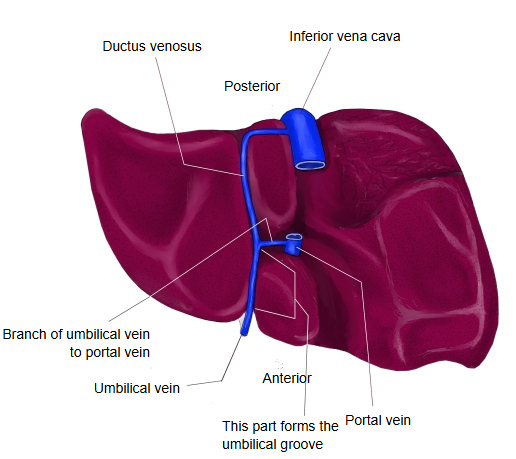
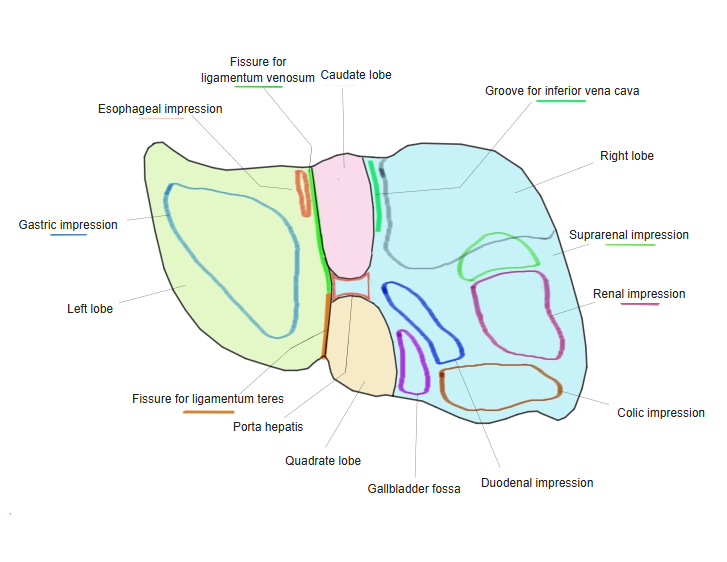
Groove for ductus venosus (Latin: fossa ductus venosi)
The groove for ductus venosus is the groove on the visceral surface (lower surface) of the liver, between the caudate lobe and the left lobe, through which the ductus venosus passes.
Ductus venosus: the continuation of the umbilical vein; it carries oxygen-rich blood to the inferior vena cava
This is the name used in the fetal period. After birth the ductus venosus closes and becomes the ligamentum venosum, so the groove is then called the fissure for ligamentum venosum.
Fetal period: from about the 9th week of pregnancy to birthA cord of connective tissue that no longer works as a blood vessel
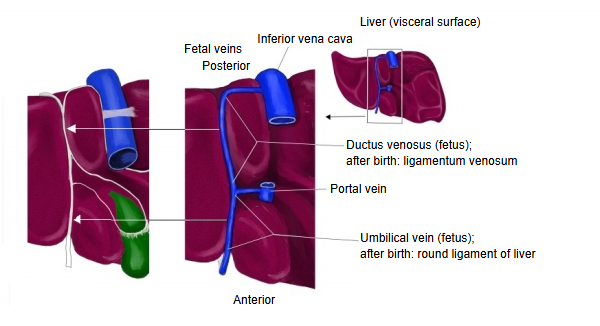
Fetal
period
↓
after
birth
period
↓
after
birth
- Umbilical vein ⇒ Round ligament of liver : the umbilical vein (carrying oxygen-rich blood from the umbilicus to the liver) becomes a fibrous cord, the round ligament of liver, after birth.
- Groove for umbilical vein ⇒ Fissure for round ligament : the groove through which the umbilical vein passed becomes the fissure for the round ligament.
- Ductus venosus ⇒ Ligamentum venosum : the ductus venosus, the continuation of the umbilical vein, becomes a fibrous cord, the ligamentum venosum, after birth.
- Groove for ductus venosus ⇒ Fissure for ligamentum venosum : the groove through which the ductus venosus passed becomes the fissure for the ligamentum venosum.
 Fetal veins on the liver
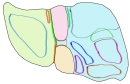 Features of the visceral surface