Groove for vertebral artery (Latin: sulcus arteriae vertebralis)
· It runs from lateral and front to medial and back.
· The vertebral artery and the suboccipital nerve pass through it.
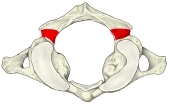 Atlas (superior view)
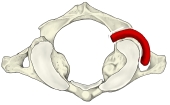 Vertebral artery on the atlas
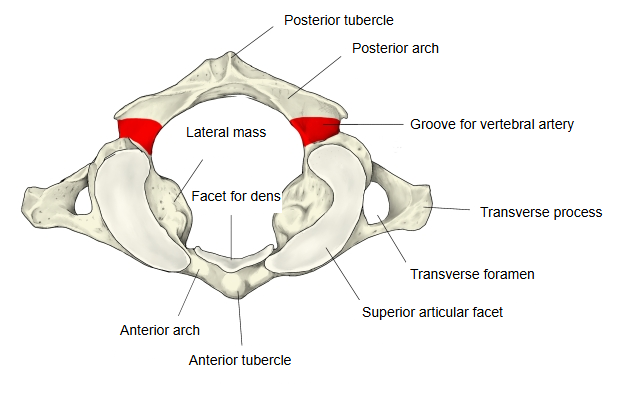
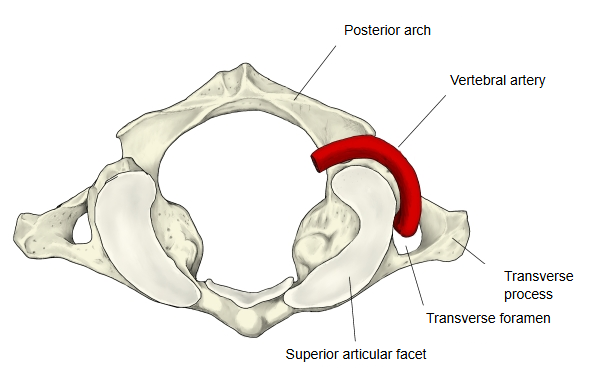
The groove lies on the upper surface where the posterior arch passes into the lateral mass, and runs from lateral and front to medial and back. The vertebral artery and the suboccipital nerve run in it. The posterior atlanto-occipital membrane is attached to the raised line along its posterior edge. A bony bridge sometimes arches over the groove to the lateral mass and turns it into a canal (ponticulus posticus).
In other words:
After leaving the transverse foramen of the atlas, the vertebral artery turns backwards round the lateral mass in this groove and passes medially toward the foramen magnum; it pierces the posterior atlanto-occipital membrane and enters the skull. The suboccipital nerve (dorsal ramus of the 1st cervical nerve) lies between the artery and the bone.
Related terms
- Atlas
- Posterior arch of atlas
- Lateral mass of atlas
- Transverse foramen
- Vertebral artery
- Suboccipital nerve
- Posterior atlanto-occipital membrane
References and sources
- Further reading: Atlas (anatomy), Wikipedia.
- Further reading: Vertebral artery, Wikipedia.
- Federative International Programme for Anatomical Terminology (FIPAT). Terminologia Anatomica, 2nd ed. (TA2), 2019.