Haustra of colon (Latin: haustra coli)
Also called Haustra (singular: haustrum) or the colonic sacculations
- Overview
- How haustra form
- Function
- Differences between regions
- Reference websites
- (Wikipedia, websites with illustrations)
- Related terms
Overview
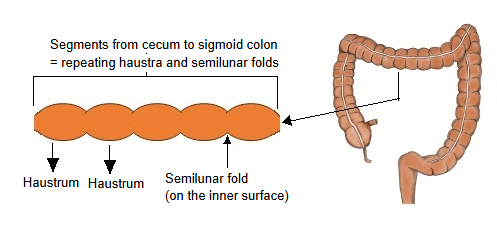
In other words, the colon from the cecum to the sigmoid colon can be seen as a chain of haustra. They are not fixed structures: their position and depth change as the circular muscle contracts and relaxes.
How haustra form
In short, the haustra form as follows.
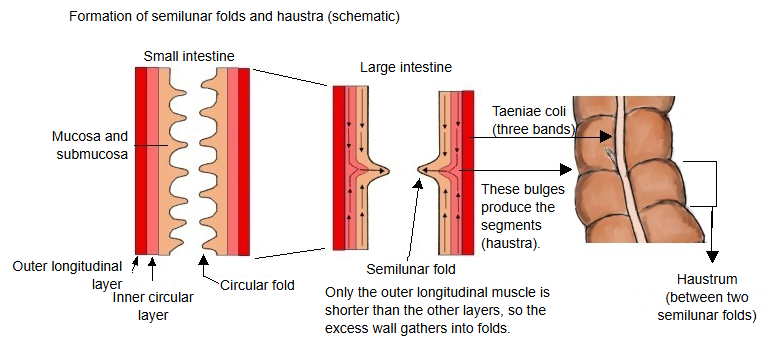
1. 1. The outer longitudinal muscle is gathered into the three taeniae coli, which are relatively short.
2. 2. The colon tends to shorten along its length to match the length of the taeniae coli.
3. 3. As a result the intestinal wall is gathered up lengthwise, like cloth on a drawstring, and together with local contraction of the circular muscle this forms the semilunar folds on the inner side.
4. 4. The combined pull of the three taeniae coli and these local contractions give the intestine a look of ring-like constrictions (the forming of the haustra).
5. 5. Because this pattern repeats at fairly regular intervals, the intestine from the cecum to the sigmoid colon becomes a repeating series of haustra and semilunar folds.
How haustra form
Function
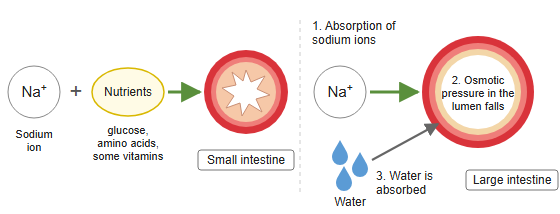
So in the large intestine the steps are:
absorption of sodium ions (Na⁺) ⇒ fall of the osmotic pressure of the intestinal contents ⇒ absorption of water
How does this differ from the small intestine?
The small intestine also absorbs sodium ions, but much of it is coupled to nutrients (co-transport with glucose, amino acids and some vitamins), so it serves mainly to absorb nutrients. The large intestine has well-developed routes that absorb sodium ions on their own, and this drives the absorption of water (water follows the sodium by osmosis).
Either way, when sodium absorption works normally, nutrients are absorbed efficiently in the small intestine and water in the large intestine.
Slow mixing movements of the haustra (haustral churning) also move the contents back and forth between neighbouring pouches.
Differences between regions
The haustra differ from one part of the large intestine to another, as follows. The numbers are rough guides; they vary between people and between sources.
| Part | Number (approx.) | Size | Shape | Notes | |
|---|---|---|---|---|---|
| 1 | Cecum | Few (about 2–4) | Large | Irregular, prominent bulges | Holds much content; the most easily distended part |
| 2 | Ascending colon | Moderate (5–8) | Large to medium | Clear haustra | Taeniae coli well marked |
| 3 | Transverse colon | Many (8–12) | Medium | Regular and typical | The textbook pattern |
| 4 | Descending colon | Rather few (5–8) | Medium to small | Haustra become shallower | Contents become solid |
| 5 | Sigmoid colon | Few (3–6) | Small to medium | Irregular, very variable | Very mobile; large differences between people |
| 6 | Rectum | 0 | – | No haustra | The taeniae coli also disappear |
Reference websites
[Wikipedia]
· Haustrum (anatomy), Wikipedia.
[Websites with illustrations]
· Colon with haustra, taeniae and semilunar folds (figure) (Elsevier)

· The large intestine (TeachMeAnatomy)
· Large intestine (Kenhub)
Related terms
References and sources
- Further reading: Haustrum (anatomy), Wikipedia.
- Federative International Programme for Anatomical Terminology (FIPAT). Terminologia Anatomica, 2nd ed. (TA2), 2019.