Semilunar folds of colon (Latin: plicae semilunares coli)
Overview
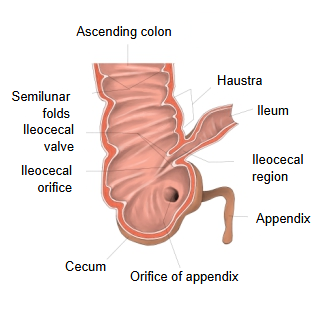
The semilunar folds of the colon are discontinuous transverse folds seen in the lumen of the large intestine, mainly of the colon.
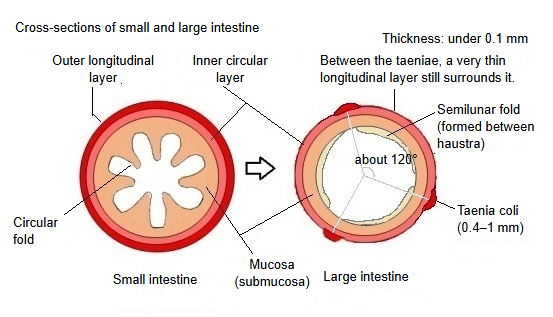
In the cecum they are indistinct, and the rectum normally has noneEach fold takes up about a third to a half of the circumference of the lumen
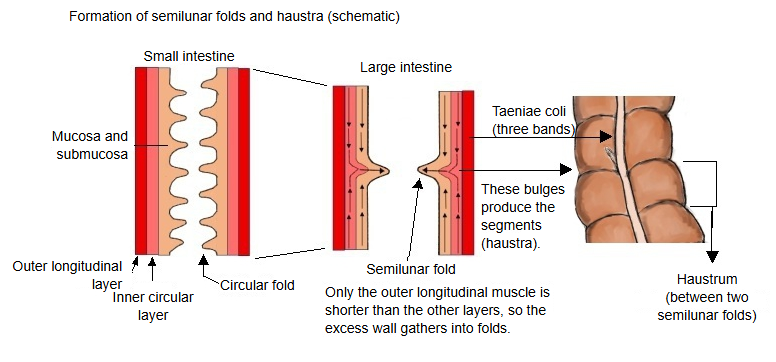
The semilunar folds are caused by the taeniae coli, so usually three of them can be seen at about the same level.
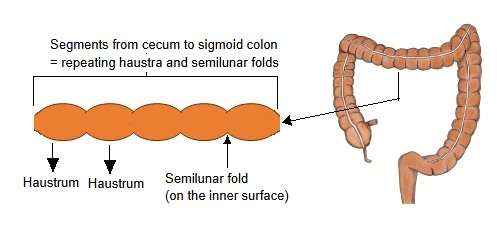
The three taeniae coli are shorter than the rest of the wall, so the wall is gathered into pouches (haustra) and bulges into the lumen as folds between them
The folds mark the borders between the haustra. Unlike the circular folds of the small intestine, which are folds of the mucosa and submucosa only, the semilunar folds also include the circular muscle layer. They are seen from the cecum to the sigmoid colon; the ileocecal valve lies at the junction of the ileum and the cecum.
Reference websites
[Wikipedia]
· Haustrum (anatomy), Wikipedia.
· Large intestine, Wikipedia.
Related terms
References and sources
- Further reading: Haustrum (anatomy), Wikipedia.
- Further reading: Large intestine, Wikipedia.
- Federative International Programme for Anatomical Terminology (FIPAT). Terminologia Anatomica, 2nd ed. (TA2), 2019.