Inferior lobe (Latin: lobus inferior pulmonis)
Also called Lower lobe (of lung)
The inferior lobe is the lowest lobe of each lung, lying below and behind the oblique fissure. For the lobes of the lung, see Pulmonary lobe.
See: Pulmonary lobe
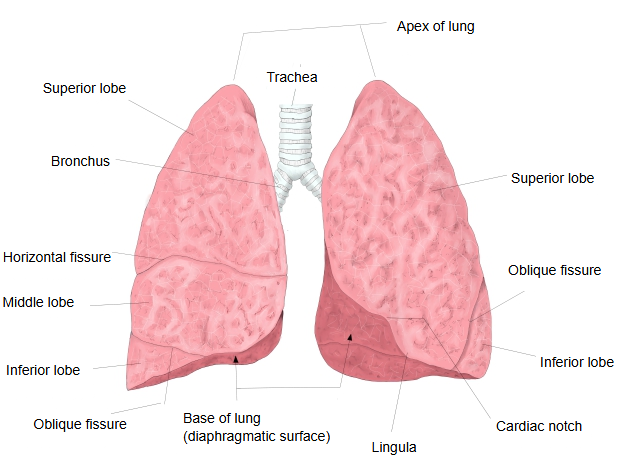
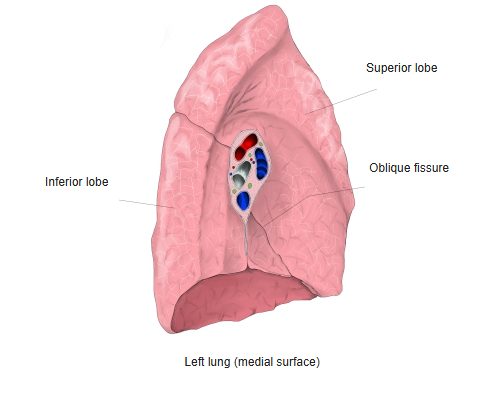
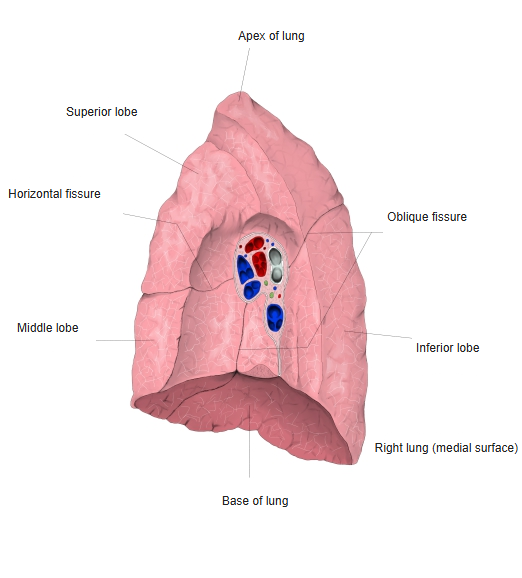
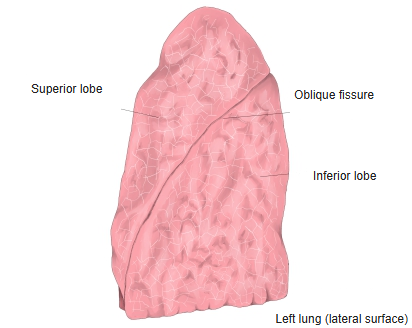
· Both lungs have an inferior lobe. It is roughly half-cone shaped and is usually the largest lobe of each lung; the superior lobe (and on the right the middle lobe) lies in front of and above it.
· It forms most of the base (diaphragmatic surface) and most of the posterior part of the lung, so it lies mainly in the back of the chest; from the front, little of it is seen.
· Its upper end reaches up behind to about the level of the spine of the 3rd–4th thoracic vertebra, where the oblique fissure begins.
· It is supplied by the inferior lobar bronchus (see bronchi): on the right, from the common stem below the middle lobar bronchus; on the left, from the main bronchus below the superior lobar bronchus.
· Segments: superior and the basal segments (medial, anterior, lateral and posterior basal). The medial basal segment is often small or merged with the anterior basal on the left; sources differ on the count.
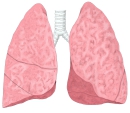 Lungs (anterior view)
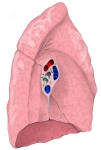 Left lung (medial surface)
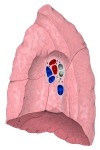 Right lung (medial surface)
 Left lung (lateral surface)
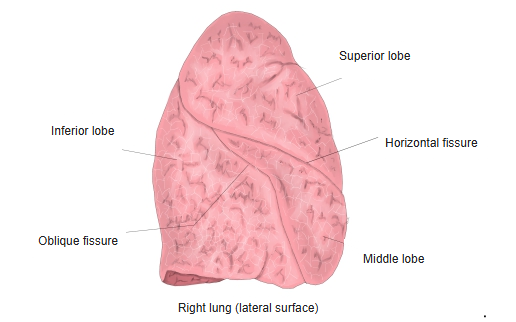
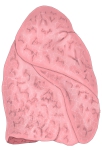 Right lung (lateral surface)
Where it is found
Related terms
References and sources
- Further reading: Lung, Wikipedia.
- Further reading: Bronchopulmonary segment, Wikipedia.
- Federative International Programme for Anatomical Terminology (FIPAT). Terminologia Anatomica, 2nd ed. (TA2), 2019.