Superior lobe (Latin: lobus superior pulmonis)
Also called Upper lobe (of lung)
The superior lobe is the uppermost lobe of each lung, containing the apex; it lies above and in front of the oblique fissure. For the lobes of the lung, see Pulmonary lobe.
See: Pulmonary lobe
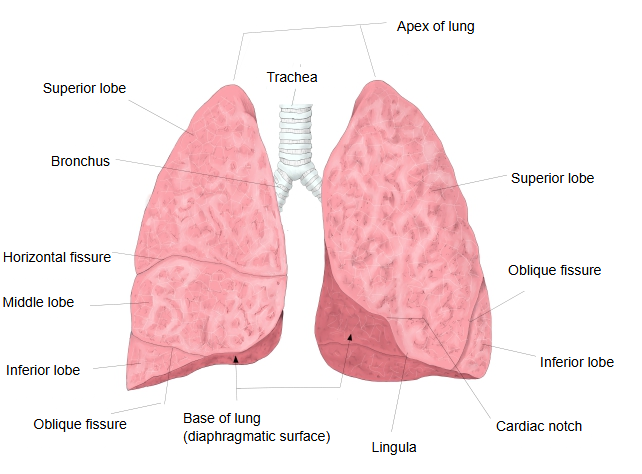
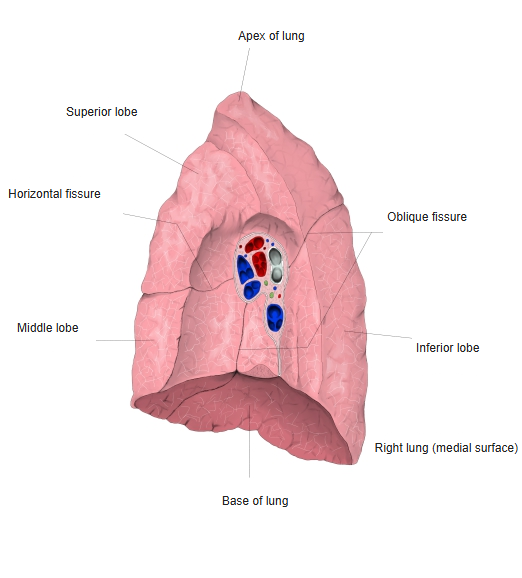
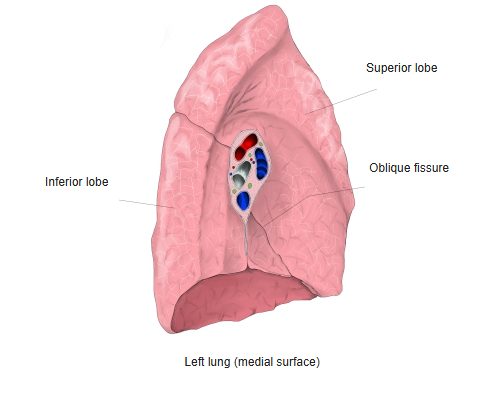
· Both lungs have a superior lobe. In the right lung it is separated from the middle lobe by the horizontal fissure and from the inferior lobe by the oblique fissure; in the left lung only the oblique fissure separates it from the inferior lobe.
· It forms the apex and most of the front of each lung; the inferior lobe lies mainly behind and below.
· The left superior lobe is the larger of the two, because it also includes the lingula, the counterpart of the right middle lobe.
· Each lobe is wrapped in visceral pleura, which dips into the fissures; neighbouring lobes are joined only at the hilum by their bronchi and vessels.
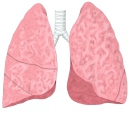 Lungs (anterior view)
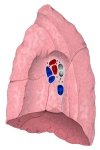 Right lung (medial surface)
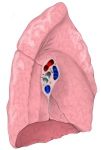 Left lung (medial surface)
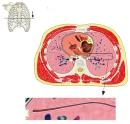 Section of the thorax at T8
 Lobes separated
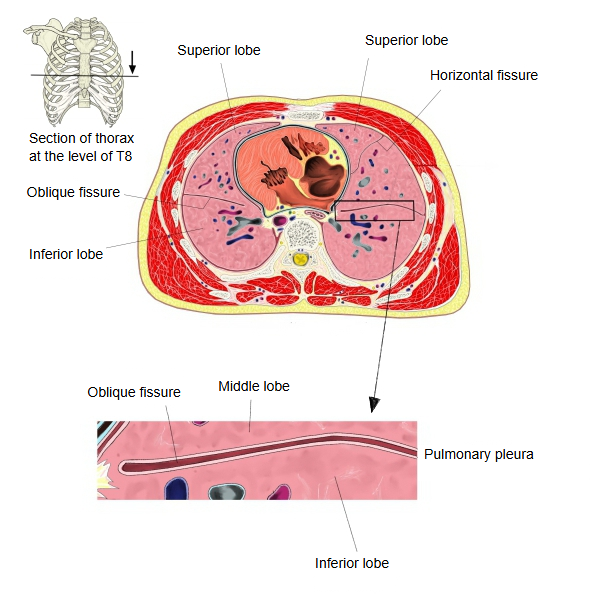
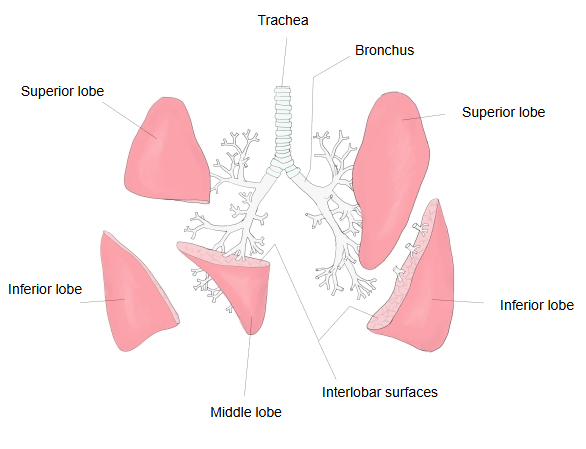
Right superior lobe
· Supplied by the right superior lobar bronchus, the first branch of the right main bronchus, which arises above the pulmonary artery (the eparterial bronchus). See lobar bronchus.
· Three bronchopulmonary segments: apical, posterior and anterior.
Left superior lobe
· Supplied by the left superior lobar bronchus, which divides into an upper division and the lingular bronchus.
· Segments: apicoposterior (often counted as two), anterior, and the superior and inferior lingular segments. Sources differ on whether the apical and posterior segments are counted separately on the left.
Where it is found
Related terms
References and sources
- Further reading: Lobes of lung, Wikipedia.
- Further reading: Bronchopulmonary segment, Wikipedia.
- Federative International Programme for Anatomical Terminology (FIPAT). Terminologia Anatomica, 2nd ed. (TA2), 2019.