Inferior thoracic aperture (Latin: apertura thoracis inferior)
Also called the thoracic outlet, outlet of thorax
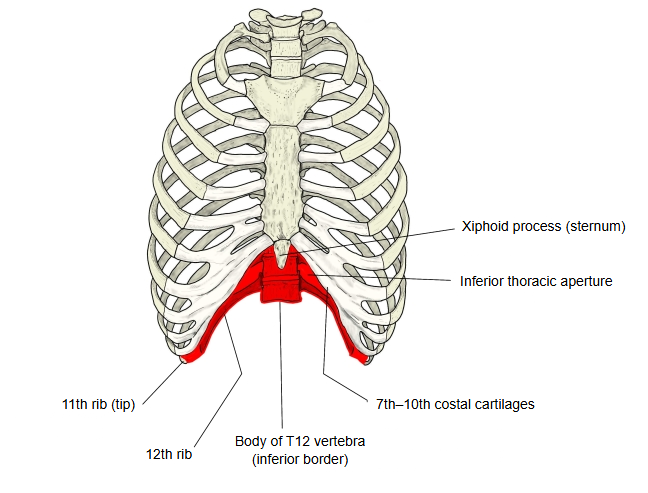
The inferior thoracic aperture is the lower opening of the thoracic cage, closed in life by the diaphragm.
It is bounded by the xiphoid process of the sternum, the 7th to 10th costal cartilages, the 11th and 12th ribs and the lower border of the body of the 12th thoracic vertebra.
It is much wider and more irregular than the superior thoracic aperture. Its margin is the line that joins the body of the 12th thoracic vertebra, the 12th ribs, the tips of the 11th ribs, the costal arches and the lower end of the xiphoid process; it is high in front and at the back and lowest at the sides. The diaphragm is attached all around it, so it marks the boundary between the thoracic and abdominal cavities; the aorta, oesophagus and inferior vena cava pass through the diaphragm here.
thoracic
aperture
- Body of the 12th thoracic vertebra : its lower border
- 11th and 12th ribs : for the 11th rib, its tip
- 7th to 10th costal cartilages : they form the costal arch
- Sternum : its xiphoid process
Other English names for the opening are thoracic outlet and outlet of thorax.
In clinical use, however, "thoracic outlet" (as in thoracic outlet syndrome) usually means the region of the superior thoracic aperture. Sources differ, so the anatomical name inferior thoracic aperture is clearer for this opening.
Related terms
References and sources
- Further reading: Thorax, Wikipedia.
- Federative International Programme for Anatomical Terminology (FIPAT). Terminologia Anatomica, 2nd ed. (TA2), 2019.